Estimate vs Invoice: What’s the Difference and When to Use Each?
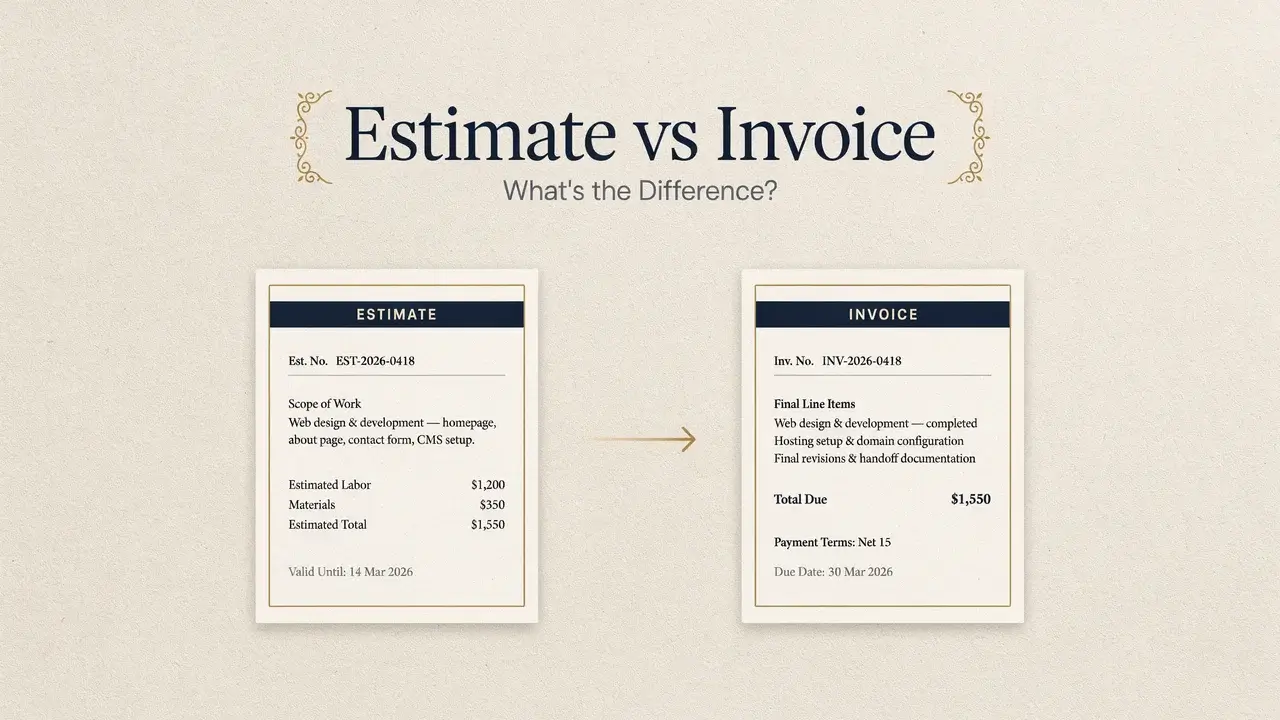
An estimate vs invoice comparison starts with one simple difference. An estimate tells a customer what a job is expected to cost. An invoice requests payment for an amount that is now being charged.
Both documents may contain similar details, including services, quantities, rates, and totals. Their purpose and timing are different.
A business may send an estimate before work begins. Once the customer approves the work and the amount is ready to bill, the business can create an invoice.
Estimate vs Invoice: Quick Comparison
| Feature | Estimate | Invoice |
|---|---|---|
| Main purpose | Show expected cost | Request payment |
| Usually sent | Before work begins | When an amount becomes billable |
| Price | Expected or projected | Amount being charged |
| Payment requested | No | Yes |
| Customer action | Review and approve | Pay |
| Important date | Valid-until date | Payment due date |
| Can amounts change? | Often, depending on scope and agreement | Should reflect the agreed or actual charge |
| Accounting role | Pre-sale document | Billing document |
| Can become an invoice? | Yes | Not applicable |
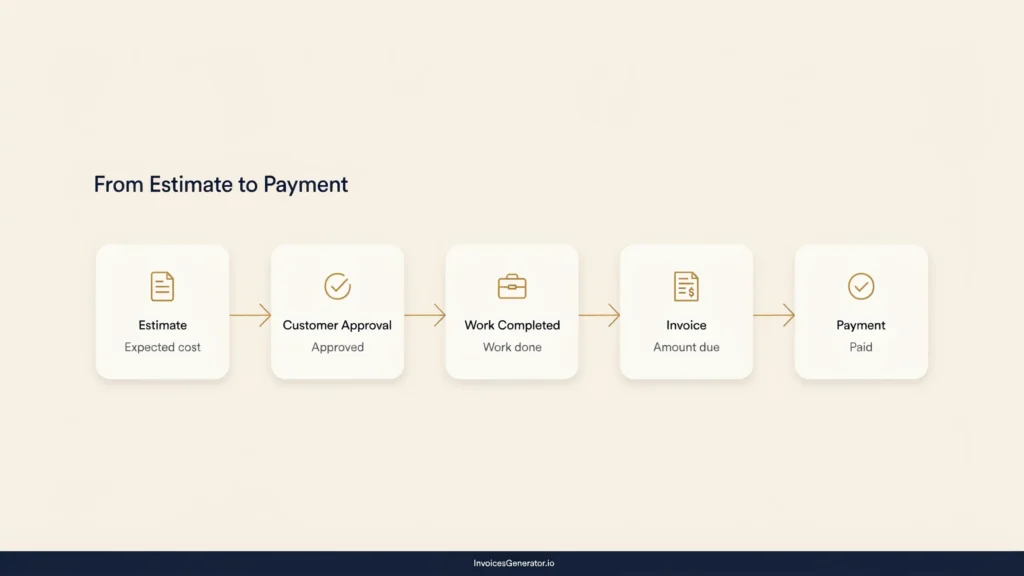
The easiest way to remember the difference is:
Estimate → Approval → Work → Invoice → Payment
What Is an Estimate?
An estimate gives a customer an expected price before the final charge is known.
Businesses commonly use estimates when a project involves uncertain labor, materials, quantities, or scope.
For example, a contractor may inspect a repair and estimate the cost at $2,500. The actual cost may change if extra work becomes necessary.
An estimate normally includes:
- Business and customer details
- Estimate number
- Date issued
- Description of work
- Expected quantities
- Estimated labor charges
- Material costs
- Estimated total
- Taxes, where relevant
- Validity period
- Assumptions or exclusions
An estimate can look similar to an invoice. However, it does not normally ask the customer to pay the estimated total.
Its main role is to help the customer understand the expected cost before deciding whether to proceed.
What Is an Invoice?
An invoice is a document used to request payment from a customer.
It tells the customer what they are being charged, how much they owe, and when payment is due.
A typical invoice includes:
- Business details
- Customer details
- Unique invoice number
- Issue date
- Due date
- Products or services
- Quantity and rates
- Taxes and discounts
- Total amount due
- Payment terms
- Payment instructions
An invoice does not always have to wait until an entire project is finished.
Businesses may invoice after completion, at an agreed milestone, for a deposit, or according to a recurring billing schedule.
Once you are ready to charge a client, you can create the document using our free invoice generator.
What Is the Difference Between an Estimate and an Invoice?
The main difference between an invoice and an estimate is what the document asks the customer to do.
An estimate asks the customer to review an expected price.
An invoice asks the customer to pay an amount due.
Several other differences follow from that basic distinction.
1. Purpose
An estimate helps a potential customer understand expected costs before proceeding.
It can support the decision to approve a project, request changes, or decline the work.
An invoice has a different purpose.
It communicates an amount being charged and requests payment according to the stated terms.
2. Timing
Estimates usually belong near the beginning of a transaction.
A customer might request one before:
- Hiring a contractor
- Approving repairs
- Starting a design project
- Booking custom work
- Authorizing consulting services
Invoices appear later, once there is an amount that should be billed.
That might happen after completing the job or reaching an agreed payment milestone.
3. Expected Price vs Amount Due
An estimate contains a projected cost.
That projection may be based on expected labor, materials, time, and scope.
An invoice contains the amount the business is actually charging at that stage.
The two totals may match exactly.
They can also differ when the scope or actual costs change.
4. Customer Action
An estimate usually needs review.
The customer may:
- Accept it
- Reject it
- Ask for changes
- Discuss the scope
- Request clarification
An invoice needs a different response. The customer checks the charges and pays according to the agreed payment terms.
5. Validity Date vs Payment Due Date
An estimate may contain a validity period.
For example:
Estimate valid until: September 30
This tells the customer how long the proposed pricing remains available. An invoice generally uses a payment due date instead.
For example:
Payment due: October 30
These dates serve different purposes.
One shows how long the proposed pricing remains current. The other tells the customer when payment is expected.
6. Accounting Role
An estimate usually sits before the actual billing transaction.
It helps define expected pricing and scope but does not normally record money owed in the same way as an invoice.
An invoice becomes part of the billing process because it records an amount being charged to the customer.
Exact accounting treatment can vary by accounting system and business structure.
Estimate vs Invoice Example
Imagine a landscaping company is asked to redesign a small backyard.
Before starting, it calculates:
| Item | Estimated Cost |
|---|---|
| Labor | $1,500 |
| Plants and soil | $500 |
| Timber and materials | $300 |
| Estimated total | $2,300 |
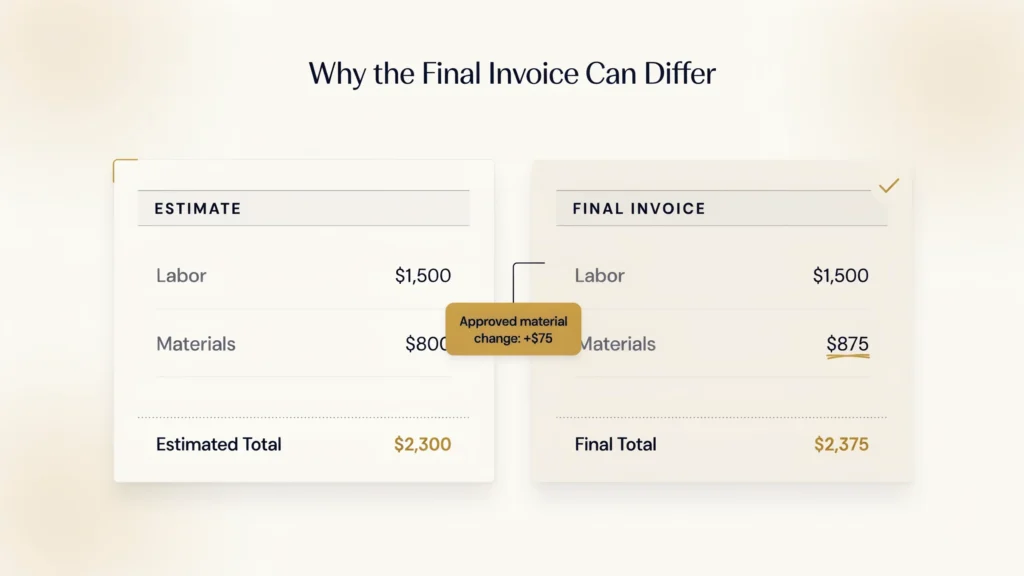
The company sends the customer an estimate for $2,300.
The customer approves the work. During the project, the customer requests extra plants costing $150.
The completed job now costs:
| Item | Final Charge |
|---|---|
| Labor | $1,500 |
| Plants and soil | $650 |
| Timber and materials | $300 |
| Invoice total | $2,450 |
The final invoice is $150 higher because the scope changed.
The important part is communication. The customer should know about approved changes rather than discovering unexpected charges only when the invoice arrives.
Can You Convert an Estimate Into an Invoice?
Yes.
Converting an approved estimate into an invoice is a common workflow.
It can look like this:
Create estimate → Customer accepts → Complete work → Review changes → Create invoice → Request payment
The invoice can reuse details already entered in the estimate, such as:
- Customer information
- Products or services
- Descriptions
- Quantities
- Rates
- Approved scope
Before sending the invoice, review the information carefully and update anything that changed during the project.
What Should Change When an Estimate Becomes an Invoice?
Do not simply rename the estimate and send it unchanged.
Review the job first.
Details that may stay the same include:
- Business name
- Customer details
- Service descriptions
- Approved rates
- Tax information
- Original project scope
Other details should be updated.
Replace the Estimate Number
An invoice should have its own invoice number. Keep estimate and invoice references distinct for easier recordkeeping.
Replace the Validity Date
The estimate’s validity period is no longer the main date. The invoice should contain an issue date and payment due date.
Check the Final Amount
Replace projected amounts with the actual or agreed charges. Include approved changes to labor, materials, quantities, or scope.
Account for Deposits
If the customer already paid a deposit, show it correctly when calculating the remaining balance.
Add Payment Instructions
The invoice should clearly explain how the customer can pay. Include the payment method, due date, and any other relevant terms.
Can an Invoice Be Higher Than an Estimate?
It can be, depending on what changed and what the customer agreed to.
Common reasons include:
- Customer requests extra work
- More materials are required
- Material prices change
- Hidden problems are discovered
- The project takes longer than expected
- Original quantities change
That does not mean businesses should treat an estimate as permission to charge any amount later.
Material changes should be discussed with the customer as early as possible.
For example, suppose a repair was estimated at $800. After opening the equipment, the technician discovers another damaged component.
The better approach is to explain the additional work and updated expected cost before proceeding when possible.
This reduces billing disputes and gives the customer a chance to approve the change.
Can the Final Invoice Be Lower Than the Estimate?
Yes.
An estimate is an expected cost, not a target that must always be reached. Suppose a business estimates eight hours of labor but finishes in six.
If the agreement bills actual hours, the invoice may be lower than the original estimate.
Other reasons include:
- Fewer materials were needed
- Material costs decreased
- Part of the work became unnecessary
- The project finished faster
- The customer removed part of the scope
The final invoice should reflect the pricing arrangement and work actually being billed.
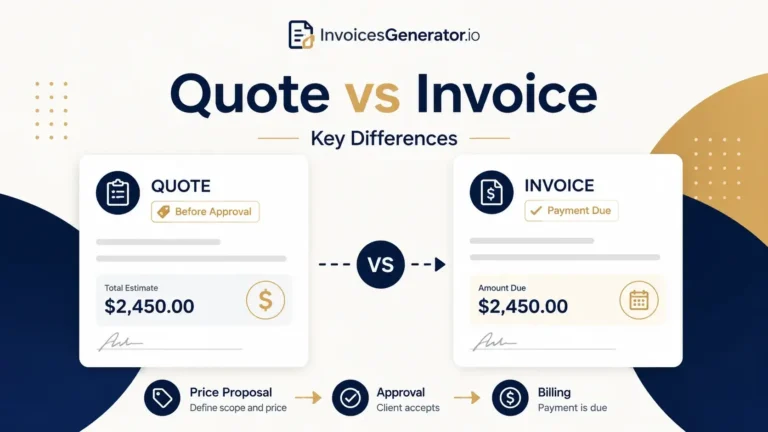
Estimate vs Quote vs Invoice
Estimates, quotes, and invoices appear at different points in a transaction.
| Document | Purpose |
|---|---|
| Estimate | Gives an expected or approximate cost |
| Quote | Presents pricing for defined work |
| Invoice | Requests payment |
An estimate is useful when the final cost is still uncertain.
A quote is often used when the business can provide firmer pricing for a defined scope. An invoice comes when the business is ready to charge.
The exact meaning and legal effect of estimates and quotes can vary by agreement and jurisdiction.
For a deeper comparison, read our guide on quote vs invoice.
If you need to prepare pricing before invoicing, you can also use our free quote template.
Do You Need an Estimate Before Sending an Invoice?
No.
Not every transaction requires an estimate.
An estimate makes the most sense when the customer needs expected pricing before agreeing to the work.
Examples include:
- Home repairs
- Construction projects
- Landscaping
- Custom design
- Freelance projects
- Consulting
- Equipment repairs
- Custom manufacturing
An estimate may be unnecessary when pricing is already clear.
For example:
- Fixed monthly services
- Subscription charges
- Pre-agreed contract rates
- Standard product purchases
- Regular retainers
- Recurring maintenance agreements
In these situations, the business may move directly to invoicing when payment becomes due.
When Should You Send an Estimate?
Send an estimate when a customer needs expected pricing before making a decision.
It is particularly useful when:
- The scope is not fully fixed
- Labor hours may vary
- Material requirements are uncertain
- The customer needs approval internally
- You need to outline expected work
- Pricing may depend on final quantities
- The customer wants costs before committing
An estimate helps both sides discuss the work before billing begins.
When Should You Send an Invoice?
Send an invoice when an agreed amount becomes ready for payment.
Common situations include:
- Work has been completed
- Products have been delivered
- A project reaches a billing milestone
- A deposit becomes due
- A recurring billing date arrives
- An agreed stage of work is complete
For professional services, the invoice should clearly match the agreed scope and payment terms.
You can create and download one using the free invoice generator.
Common Estimate and Invoice Mistakes
Understanding estimate vs invoice terminology is useful, but the workflow matters just as much.
Avoid these common mistakes.
Treating an Estimate as the Final Invoice
An estimate provides expected pricing.
Send an invoice when you actually need to request payment.
Failing to Explain Price Changes
If the final amount differs materially from the estimate, explain why.
Document approved additions or changes.
Forgetting an Estimate Validity Period
Prices may change over time.
A validity date tells the customer how long the proposed pricing remains current.
Leaving the Invoice Due Date Unclear
Customers should know when payment is expected.
Use a specific date or clearly defined payment terms.
Ignoring Deposits Already Paid
A final invoice should account for deposits or prior payments correctly.
Do not ask the customer to pay the same amount twice.
Forgetting Scope Changes
If the customer adds services during the project, update your records.
The final invoice should match the agreed work being billed.
Reusing Document Numbers Carelessly
An estimate and invoice are separate business documents.
Use clear references so both sides can identify them later.
Estimate to Invoice Workflow
A simple process can prevent confusion between estimates and invoices.
1. Discuss the Customer’s Needs
Understand the expected scope before calculating pricing.
2. Prepare the Estimate
List expected services, quantities, rates, and costs.
3. Send It for Review
Give the customer time to check the work and pricing.
4. Record Approval
Keep a clear record of what the customer accepted.
5. Complete the Work
Follow the agreed scope.
6. Document Changes
Record additional work, removed items, or pricing changes.
7. Prepare the Invoice
Use the approved estimate as a starting point where appropriate.
8. Apply Previous Payments
Account for deposits or other amounts already received.
9. Send the Invoice
Include the final charge, due date, and payment instructions.
10. Record Payment
Update the invoice when the customer pays.
Estimate vs Invoice FAQs
Is an estimate the same as an invoice?
No. An estimate gives the customer an expected cost before billing. An invoice requests payment for an amount being charged.
Can an estimate be used as an invoice?
They serve different purposes. Once the customer accepts the estimate and an amount becomes billable, the estimate information can be used to create a separate invoice.
Does a customer have to pay an estimate?
An estimate itself is generally not a request for payment. Its legal effect can depend on its wording, acceptance, the surrounding agreement, and applicable law.
Can an invoice be higher than an estimate?
Yes, the final amount can differ when costs or scope change. Businesses should communicate significant changes and follow the customer’s agreement and applicable terms.
Can you convert an estimate into an invoice?
Yes. Many invoicing systems allow businesses to use an accepted estimate as the basis for creating an invoice.
Should an estimate and invoice have the same number?
It is generally clearer to give each document its own reference number. This helps distinguish the original estimate from the final invoice.
Does an estimate come before an invoice?
Usually, yes. An estimate is normally provided before work or billing, while an invoice is sent when an amount becomes due.
What is the difference between an invoice and an estimate?
An estimate communicates expected pricing. An invoice requests payment for goods, services, or an agreed billing stage.
Can an invoice be sent before work is completed?
Yes. Businesses may invoice for deposits, progress payments, milestones, or other agreed billing arrangements before the entire project is complete.
Is an estimate the same as a quote?
Not always. An estimate generally communicates expected costs, while a quote often provides firmer pricing for defined work. The exact meaning can depend on the agreement and jurisdiction.
Final Thoughts
The key difference in estimate vs invoice is purpose. An estimate helps a customer understand expected costs before billing. An invoice requests payment when an amount is ready to be charged.
For many service businesses, the process is simple:
Estimate → Approval → Work → Invoice → Payment
Use an estimate to set expectations before the job. Once the work or billing stage is ready, use our free invoice generator to create the payment request.