Invoice vs Bill: What’s the Difference and Are They the Same?
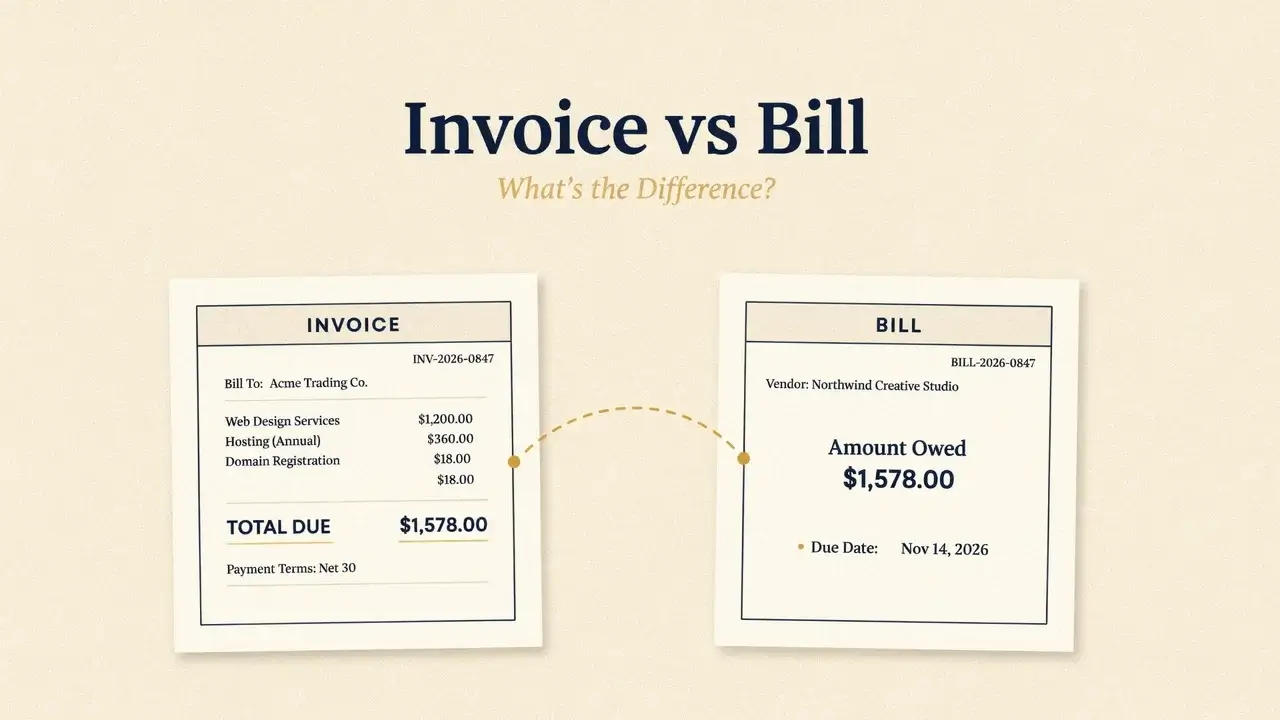
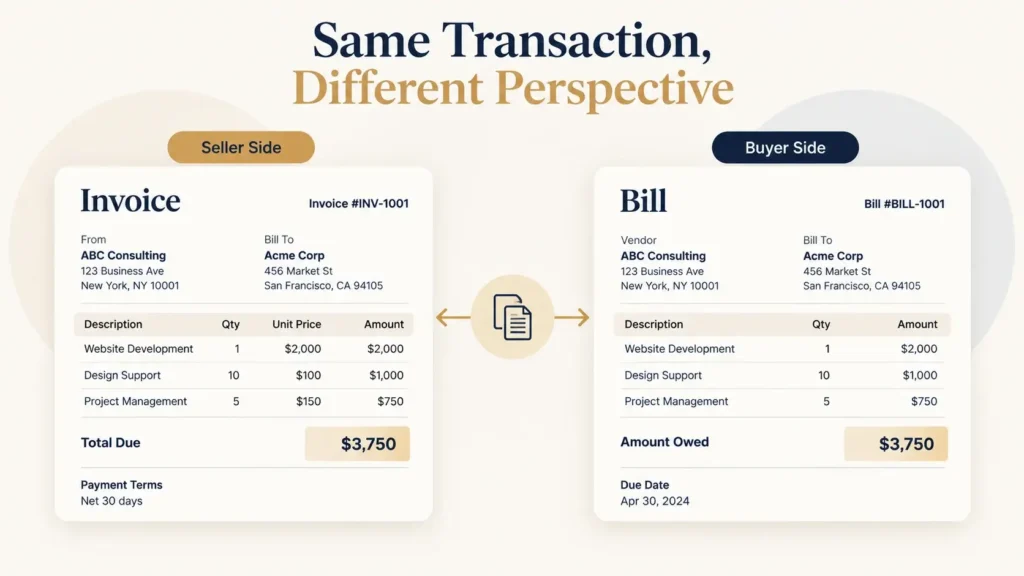
An invoice vs bill comparison can be confusing because both terms may refer to the same payment request. A seller usually sends an invoice to request payment, while the buyer may record that same document as a bill they need to pay.
The difference becomes easier to understand when you look at perspective, accounting treatment, and business context. In many cases, the document itself has not changed. Only the way each party describes it has.
Invoice vs Bill: Quick Comparison
| Feature | Invoice | Bill |
|---|---|---|
| Typical perspective | Seller | Buyer |
| Main purpose | Request payment | Show an amount owed |
| Accounting side | Accounts receivable | Accounts payable |
| Common use | Freelancers, suppliers, agencies, B2B services | Vendors, utilities, restaurants, household expenses |
| Payment timing | Often includes agreed payment terms | May be due immediately or later |
| Document details | Usually itemized and numbered | May contain the same details |
| After payment | Can be marked as paid | Can be marked as paid |
The key point is that invoices and bills are not always separate documents.
A supplier may call the document an invoice because they are requesting money. The customer receiving it may call the same document a bill because it represents money they owe.
What Is an Invoice?
An invoice is a document a seller sends to a customer requesting payment for goods or services.
It normally explains what was supplied, how much the customer owes, and when payment is expected.
A standard invoice can include:
- Seller name and contact information
- Customer details
- Unique invoice number
- Invoice date
- Description of products or services
- Quantity and unit price
- Taxes, where applicable
- Total amount due
- Payment terms
- Due date
- Payment instructions
For the seller, an unpaid invoice normally represents money that the customer still owes.
For example, a freelance designer completes a project for $1,200 and sends an invoice with a 30-day payment term. The invoice formally records the amount the client needs to pay.
You can create this type of document using our free invoice generator.
What Is a Bill?
A bill represents an amount that a buyer needs to pay. In business accounting, the term is often used for a supplier invoice received by a company.
Suppose your business hires a contractor for $900. The contractor sends an invoice requesting payment. Your company may enter that document into its accounting system as a bill.
The term is also common in everyday transactions, such as:
- Electricity bills
- Phone bills
- Restaurant bills
- Medical bills
- Internet bills
- Contractor bills
In these situations, “bill” focuses on the amount the customer owes.
What Is the Difference Between an Invoice and a Bill?
The main difference between invoice and bill is usually perspective. The seller sends a payment request.
The buyer receives an amount that needs to be paid. Several other differences come from how the terms are used in business.
Seller vs Buyer Perspective
Consider a marketing agency that completes $2,000 of work. The agency sends its client an invoice for $2,000.
For the agency, the invoice represents money it expects to collect.
The client receives the document and may enter it into its accounting system as a bill. For the client, that same $2,000 represents money it needs to pay.
So one transaction can be described differently by each party.
Accounts Receivable vs Accounts Payable
Accounting makes the distinction easier to see.
For the seller:
Invoice sent → Customer owes money → Accounts receivable
For the buyer:
Supplier invoice received → Business owes money → Accounts payable
Accounts receivable represents money customers owe a business. Accounts payable represents money a business owes suppliers or vendors.
This is one of the clearest practical differences between the two terms.
Business Context
The word “invoice” is especially common in professional and business transactions.
Examples include:
- Freelance services
- Consulting
- Contract work
- Wholesale sales
- Marketing services
- Software services
- Business-to-business purchases
The word “bill” is more common when discussing an amount that needs to be paid.
Examples include:
- Restaurant charges
- Utility services
- Medical services
- Vendor expenses
- Household services
These are common usage patterns, not strict legal rules.
Payment Timing
A common assumption is that bills must be paid immediately while invoices allow payment later.
That is not always true.
Invoices often include payment terms such as Net 15, Net 30, or another agreed due date.
Bills can also have future due dates. For example, a restaurant bill is normally paid immediately. An electricity bill may be due several weeks after it is issued.
Payment timing can influence how people use the terms, but it does not create a universal difference.
Document Detail
Invoices are commonly structured business documents.
They often include:
- Invoice numbers
- Itemized charges
- Dates
- Customer information
- Payment terms
- Tax information
- Payment instructions
Some consumer bills may contain less information.
However, a supplier invoice entered as a bill may contain exactly the same details as the original invoice.
Document detail alone does not determine whether something is a bill or invoice.
Are an Invoice and a Bill the Same Thing?
Sometimes, yes. An invoice and a bill can describe the same underlying transaction. The seller may call it an invoice because they issued it to collect payment.
The customer may call it a bill because they received it and need to pay it.
For example:
A cleaning company completes monthly office cleaning for $500. The cleaning company sends a $500 invoice. The customer receives the document and records a $500 bill.
The amount, service, due date, and document can remain the same. Only the perspective changes.
The terms are not interchangeable in every situation, though.
A restaurant customer will normally ask for the bill. A consultant requesting payment from a business client will normally send an invoice.
Invoice vs Bill in Accounting
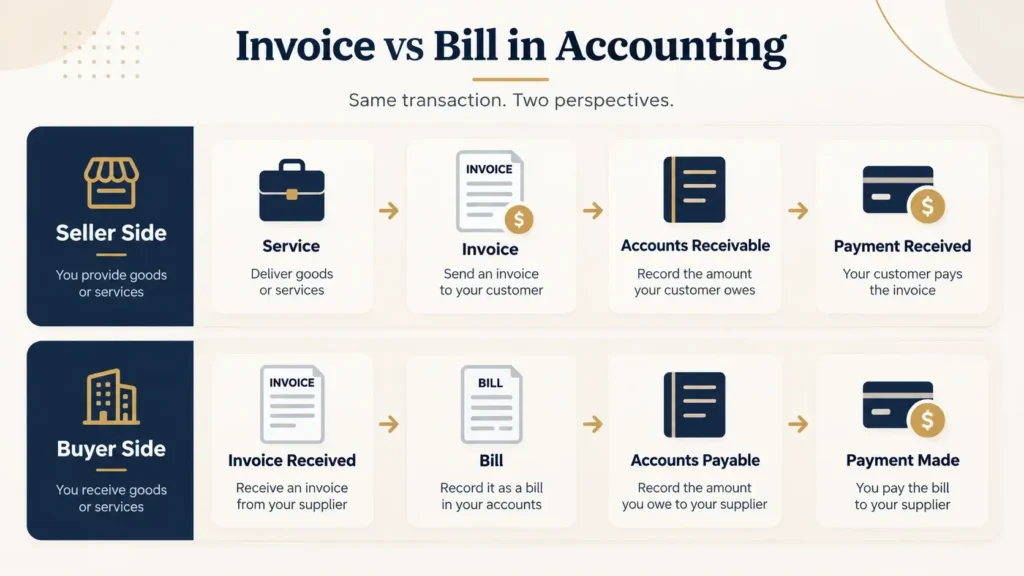
Accounting treatment provides a practical way to understand the relationship. Imagine a web development company completes a $3,000 project.
Seller’s side
The web developer sends a $3,000 invoice. The client has not paid yet. The seller records money expected from the customer.
The process looks like this:
Service completed → Invoice sent → Amount receivable → Customer pays
Buyer’s side
The client receives the supplier invoice. The client records the amount it owes the developer.
The process looks like this:
Invoice received → Bill recorded → Amount payable → Supplier paid
The transaction is the same, but each business records it from a different accounting position.
Invoice vs Bill Example
Suppose a freelance copywriter completes a website project for $1,500.
The copywriter sends:
Invoice #105
Website copywriting: $1,500
Payment due: October 15
For the copywriter, this is an invoice requesting $1,500.
For the client, the received document may become a $1,500 bill in the company’s accounting system.
The copywriter is waiting to receive money. The client is preparing to pay money.
This simple example shows why the terminology can differ even when both parties are referring to the same transaction.
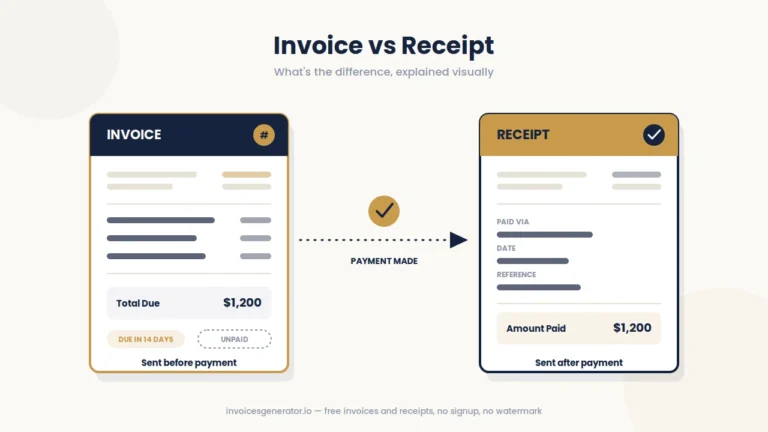
Invoice vs Bill vs Receipt
A receipt serves a different purpose from both an invoice and a bill.
| Document | Main purpose | Typical timing |
|---|---|---|
| Invoice | Request payment | Before payment |
| Bill | Show an amount owed | Before payment |
| Receipt | Confirm payment | After payment |
An invoice tells the customer how much they owe. A bill also identifies an amount that needs to be paid. A receipt confirms that payment has already been made.
Billing vs Invoicing
Billing and invoicing are closely related terms, but they are not always used in exactly the same way.
Invoicing generally refers to preparing and sending invoices to customers.
Billing can describe the wider process of calculating charges, presenting amounts owed, issuing payment requests, and collecting payments.
For example, a subscription business may operate a recurring billing system that calculates monthly charges and generates invoices for customers.
In many smaller businesses, people use “billing” and “invoicing” interchangeably.
The exact wording often depends on the company’s workflow and accounting software.
When Should You Send an Invoice?
An invoice is usually the better choice when formally requesting payment from a customer or client.
You may use one when:
- You have completed work for a client
- You provide professional services
- You sell products to another business
- Payment is due after delivery
- You need to itemize charges
- You want to state clear payment terms
- Your customer needs a document for accounting records
- You need a unique reference for payment tracking
For example, a consultant completing a $4,000 project would normally send an invoice showing the services provided, amount due, payment deadline, and payment instructions.
Our free invoice generator can help you create a clear payment request without building the document manually.
Does an Invoice Mean It Has Already Been Paid?
No.
An invoice normally requests payment. It does not prove that the customer has already paid.
Once payment is received, the invoice can be marked as paid.
The seller may also issue a receipt or payment confirmation.
This is one of the main differences between an invoice and a receipt.
Can an Invoice Be Called a Bill?
Yes.
A supplier may issue a document labeled “Invoice,” while the customer’s accounting department records it as a bill.
Everyday language also affects the terminology.
A customer might say, “Please send me the bill,” even when the business officially creates an invoice.
The terms can overlap without changing the underlying amount owed.
Is an Invoice Number the Same as a Bill Number?
It can be, but not always.
Suppose a supplier sends Invoice #4582.
The buyer may record Invoice #4582 as a bill and keep the supplier’s invoice number as the reference.
However, some accounting systems also assign their own internal bill number, transaction ID, or reference number.
This means a supplier’s invoice number and the buyer’s internal bill number should not automatically be assumed to match.
Check the document or accounting system before using one reference in place of another.
Which Term Should Your Business Use?
If you are requesting payment from a customer, invoice is generally the clearest term.
It is widely used by:
- Freelancers
- Contractors
- Agencies
- Consultants
- Service providers
- Wholesalers
- B2B companies
An invoice clearly communicates that the document is requesting payment and gives both parties a reference for the transaction.
The word “bill” remains appropriate when describing amounts owed to suppliers or in common consumer transactions.
The better term depends on the context rather than a strict rule.
Invoice vs Bill FAQs
Is an invoice and a bill the same?
They can describe the same payment request. A seller usually issues an invoice, while the buyer may record that document as a bill they need to pay.
What is the main difference between a bill and an invoice?
The main difference is usually perspective. The seller sends an invoice to collect payment. The buyer may treat the same document as a bill representing money owed.
Which comes first, a bill or an invoice?
There is not always a separate bill after an invoice. A seller can send an invoice that the buyer records as a bill.
Does an invoice mean you have paid?
No. An invoice normally requests payment. A receipt or payment confirmation is used to show that payment has been completed.
Is an invoice a bill or a receipt?
An invoice may function as a bill from the buyer’s perspective, but it is not a receipt. A receipt confirms payment.
Is an invoice number the same as a bill number?
Sometimes. The buyer may use the supplier’s invoice number when recording the bill. Some accounting systems also generate a separate internal bill reference.
What is the difference between billed and invoiced?
“Invoiced” normally means a formal invoice has been issued. “Billed” is broader and generally means a customer has been charged or asked to pay.
Can a business send a bill instead of an invoice?
Yes. The terminology varies between industries and businesses. For formal professional and B2B transactions, “invoice” is commonly used for the payment request.
Final Thoughts
The main distinction in invoice vs bill is usually perspective and business context. A seller issues an invoice to request payment, while the buyer may record that same supplier document as a bill.
Invoices are especially common in professional and B2B transactions. Bills are common in accounts payable and everyday consumer payments.
If you need to request payment from a customer, use our free invoice generator to create a clear, itemized invoice in minutes.