Pro Forma Invoice vs Invoice, Bill, and Commercial Invoice: Full Guide
Freelancers and small business owners mix up these four documents all the time. A pro forma invoice looks like a real invoice but it isn’t one yet. A bill and an invoice often describe the exact same paper, just from two different sides. A commercial invoice adds customs rules into the mix.
This guide breaks down all four documents in plain language. You will see what each one does, when to send it, and how they differ in legal weight. A comparison table further down makes the differences easy to scan.
By the end, you will know exactly which document fits your situation, whether you are billing a local client or shipping goods abroad.
What Is an Invoice
An invoice is a document a seller sends to a buyer after work is finished or goods are delivered. It requests payment for what was provided.
A standard invoice usually includes:
- Invoice number
- Seller and buyer contact details
- Itemized list of goods or services
- Total amount due
- Payment terms, like Net 30 or Net 60
Once you send an invoice, it creates a receivable in your books. It also supports your accounting and tax records, since it proves what was sold and for how much.
Some businesses send a standard invoice for one-time work. Others use a recurring invoice for ongoing retainers or monthly services.
What Makes an Invoice Legally Binding
An invoice becomes enforceable once both sides agree on the terms of sale. Payment terms like Net 30 give the buyer a set window to pay, but the debt itself is real from the moment the invoice is issued.
This is why invoices matter beyond just requesting money. They double as legal proof during audits, disputes, or tax filing season.
What Is a Bill
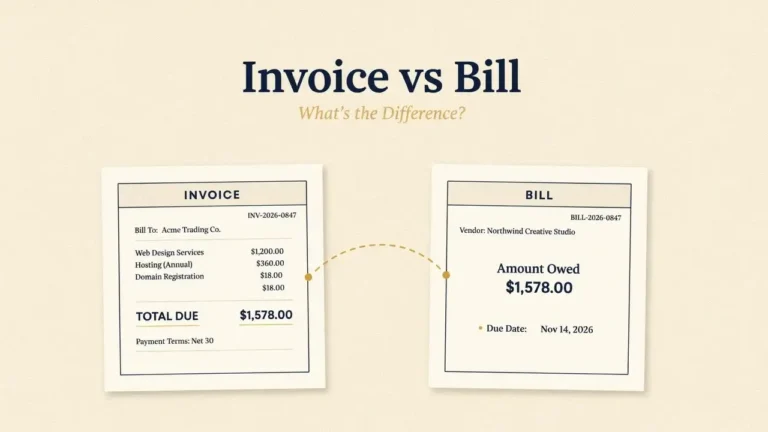
A bill is the same kind of document as an invoice, just seen from the other side. When you send an invoice to a client, they treat it as a bill they owe.
Bills show up most often in everyday, immediate transactions:
- A restaurant check handed over after a meal
- A utility bill for electricity or internet
- A retail receipt at checkout
These are usually simple, with just the total due and a short payment window. There is rarely room for detailed terms like you would find on a formal invoice.
Business owners also receive bills from their own suppliers. If you buy inventory or raw materials, your supplier sends you a bill, and in your books, you might label it a vendor bill.
The core idea to remember: the same paper can be your invoice and someone else’s bill, depending on which side of the transaction you are on.
Invoice vs Bill vs Receipt
A third document often gets thrown into this confusion: the receipt.
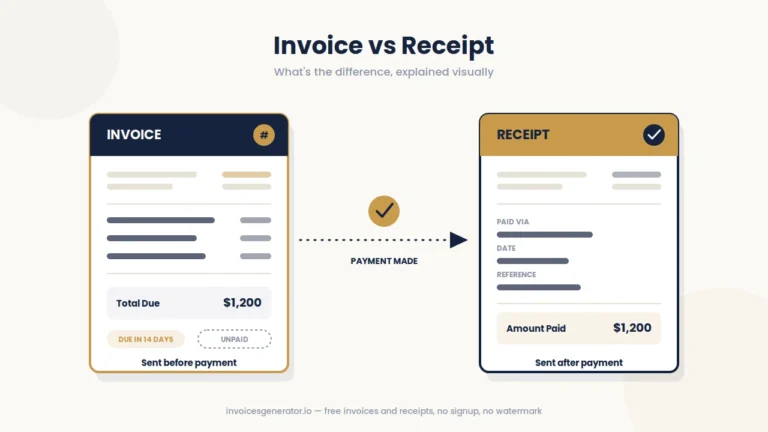
A receipt proves that payment already happened. An invoice or a bill, on the other hand, requests payment that has not been made yet. We cover this distinction in more depth in our invoice vs receipt guide.
Think of it as a simple order. A bill or invoice arrives first, asking for money. A receipt follows, confirming that money changed hands. Some receipts include a receipt number, separate from any invoice number tied to the original request.
What Is a Pro Forma Invoice
A pro forma invoice is a preliminary document sent before a sale is confirmed. Some write it as one word, proforma invoice, others as two words, pro forma invoice. Both mean the same thing.
The term comes from Latin, meaning “as a matter of form.” It works like a detailed quote rather than a real demand for payment.
Key traits of a pro forma invoice:
- Not legally binding
- No invoice number assigned
- Shows an estimated total, not a final one
- Often labeled clearly as “pro forma” to avoid confusion
Businesses use this document to help buyers plan ahead. It supports budgeting, financing requests, and letters of credit, especially before an order ships.
When Businesses Send a Pro Forma Invoice
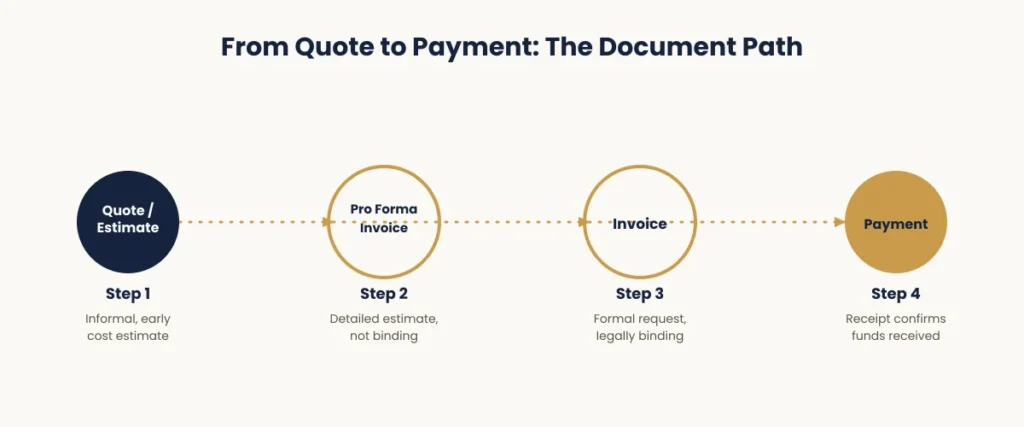
A pro forma invoice usually goes out during negotiation, before either side commits fully. It often follows a custom order or a request for exact pricing.
Buyers who ask for one are typically further along than a casual inquiry. Requesting this document signals real intent to purchase, more so than a simple quote would.
It gives both sides a chance to review costs and terms before anything becomes official.
What a Pro Forma Invoice Must Include
To work properly, a pro forma invoice needs a few key details:
- Seller and buyer information
- Estimated total cost
- Delivery terms and expected timeline
- A clear label reading “pro forma invoice, not a tax invoice”
- An issue date and an expiry date, since estimates can change
That expiry date matters. Prices quoted today may not hold if the order is delayed by weeks or months.
What Is a Commercial Invoice
A commercial invoice is the final, legally binding record of an international sale. Unlike the earlier estimate, this document confirms the actual transaction after goods ship.
It serves two roles at once. It bills the buyer for the agreed amount, and it acts as a customs declaration for the shipment crossing borders.
Customs authorities rely on this document to check what is being shipped, its value, and where it came from. Without one, goods often cannot clear customs at all.
What US Customs Requires on a Commercial Invoice
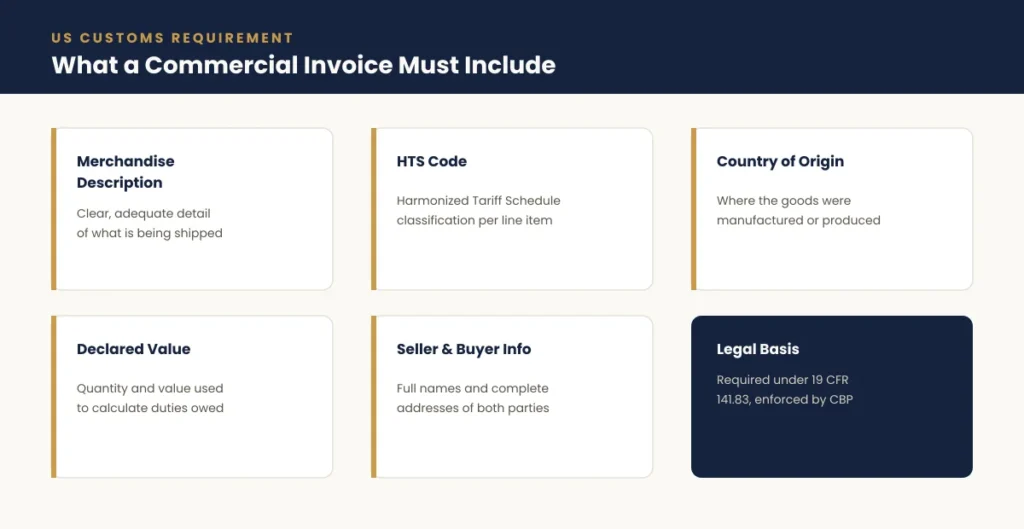
In the United States, this document is required under 19 CFR 141.83, enforced by Customs and Border Protection. CBP uses it to calculate duties and confirm the shipment matches what was declared.
A complete commercial invoice for US imports generally includes:
- A clear description of the merchandise
- Quantities and values of the goods
- The correct Harmonized Tariff Schedule (HTS) code
- Country of origin for each item
- Seller and buyer names and addresses
In some cases, a port director can waive certain fields if the information genuinely is not available at the time of release. This is the exception, not the rule.
Commercial Invoice vs Packing List
A packing list travels alongside the commercial invoice, but it does a different job.
It lists what is physically inside each package: item counts, weights, and dimensions. It does not include prices or transaction value at all.
Customs officers often check both documents together. The commercial invoice confirms value and ownership, while the packing list confirms exactly what was shipped and how.
Pro Forma Invoice vs Invoice, Side by Side
Once you understand each document alone, the differences between a pro forma invoice and a regular invoice become easier to spot.
- Timing. A pro forma invoice goes out before the sale is finalized. A real invoice goes out after work is delivered or goods are shipped.
- Legal status. A pro forma invoice is not binding and cannot be enforced. An invoice is a formal request for payment that holds legal weight.
- Numbering. Real invoices carry an invoice number for tracking and accounting. A pro forma invoice skips this, since no sale has closed yet.
- Purpose. One is a planning tool for the buyer. The other is a demand for money already owed.
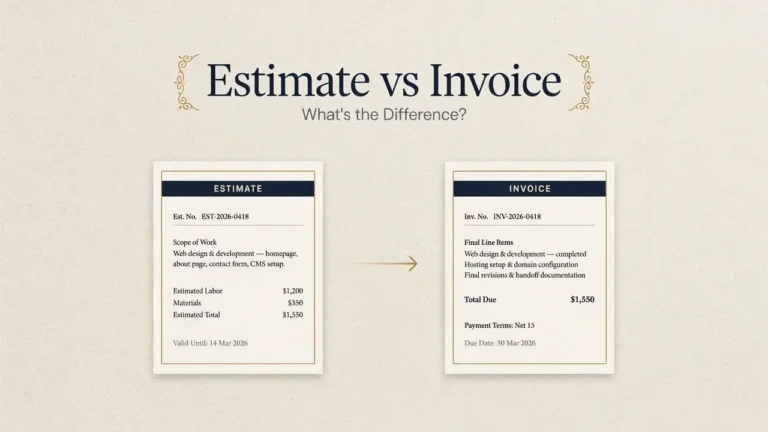
Here’s a quick example. A freelance web designer sends a client a pro forma invoice estimating a $1,650 project. Once the site is delivered, that same designer sends a real invoice for $1,650, this time with an invoice number and a due date.
Same numbers, different documents, different legal standing.
Pro Forma Invoice vs Commercial Invoice, Side by Side
These two get confused constantly in international trade, since both mention goods, pricing, and shipping details.
- Purpose. A pro forma invoice gives buyers an estimate for planning and budgeting. A commercial invoice is the final record used to bill the buyer and clear customs.
- Timing. The pro forma invoice comes first, often during negotiation. The commercial invoice comes later, once goods actually ship.
- Legal weight. Only the commercial invoice holds up as a binding sales record. A pro forma invoice carries no legal enforceability at all.
- Customs role. Customs authorities generally will not accept a pro forma invoice for clearance. They require a commercial invoice with declared value and HTS codes.
This distinction matters most for anyone shipping goods internationally, whether that’s a small exporter sending a first order abroad or a business scaling into new markets. Sending the wrong document can delay a shipment or stall payment entirely.
| Document | Purpose | Legal Status | Timing | Who Uses It | Key Requirement |
|---|---|---|---|---|---|
| Invoice | Requests payment for completed work | Legally binding | After delivery | B2B sellers, freelancers | Invoice number, payment terms |
| Bill | Requests immediate payment | Legally binding | At point of sale | Retailers, restaurants, utilities | Total due, payment deadline |
| Pro Forma Invoice | Estimates cost before a sale | Not binding | Before the sale | Sellers negotiating with buyers | Clear “pro forma” label, expiry date |
| Commercial Invoice | Final sale record and customs declaration | Legally binding | At shipment | Exporters, importers | HTS code, country of origin, declared value |
How Pro Forma Invoices Compare to Other Documents
A pro forma invoice gets confused with more than just regular invoices. Here’s how it stacks up against a few other common documents.
Pro Forma Invoice vs Quote or Quotation
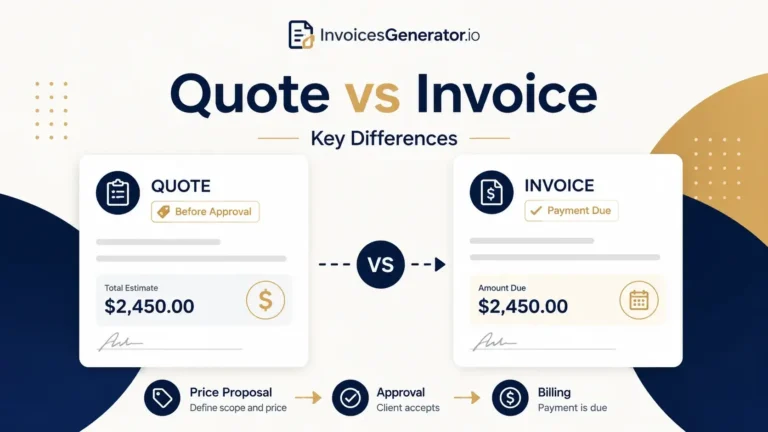
Both are non-binding and both happen before a sale closes. The difference is formality. If you want a deeper breakdown, see our full quote vs invoice comparison.
A quote is usually a rough estimate, often informal and easy to revise. A pro forma invoice looks and reads much closer to a final bill, even though it isn’t one yet.
Pro Forma Invoice vs Purchase Order
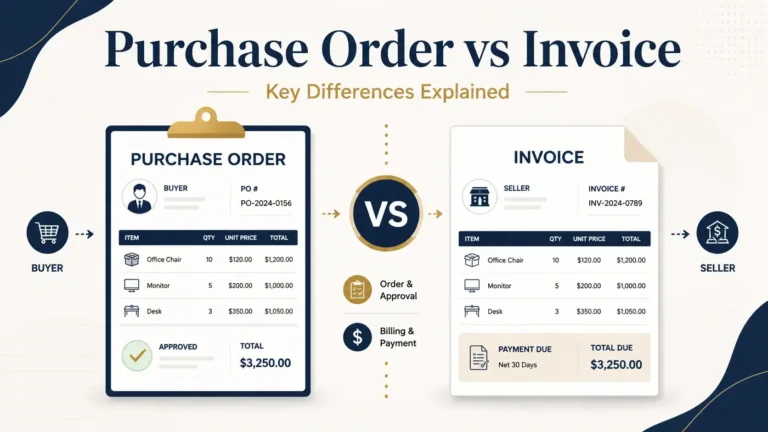
These two come from opposite directions. A pro forma invoice comes from the seller. A purchase order comes from the buyer, requesting goods or services.
Once a purchase order is accepted, it becomes fully binding. A pro forma invoice never reaches that level, no matter how detailed it gets.
Pro Forma Invoice vs Tax Invoice
A tax invoice reports the actual tax owed on a completed sale. It reflects real numbers tied to a finished transaction.
A pro forma invoice only estimates that tax, since the sale itself has not been finalized. Any tax figure on it is subject to change.
Pro Forma Invoice vs Sales Order
A sales order is mostly internal. It confirms to a business’s own fulfillment team that an order needs to be processed.
A pro forma invoice faces outward, toward the buyer. One document coordinates internal operations, the other communicates cost expectations externally.
Do Shipping Carriers Require a Pro Forma or Commercial Invoice
If you ship internationally, carriers like FedEx, DHL, and UPS will ask for specific paperwork depending on the stage of your shipment.
For most dutiable international shipments, carriers require a commercial invoice. Customs authorities use it to calculate duties and confirm the shipment matches what was declared.
A pro forma invoice sometimes works for earlier stages, like:
- Getting a preliminary shipping quote
- Applying for an import permit before goods are ready
- Supporting a letter of credit application
Once the shipment is actually ready to move, most carriers and customs offices will ask for a full commercial invoice instead.
Exact requirements vary by carrier, destination country, and the type of goods being shipped. If you ship regularly, it’s worth checking your specific carrier’s documentation page before each shipment, since rules can shift by region.
Which Document Should You Send
With four documents in play, here’s a simple way to decide which one fits your situation.
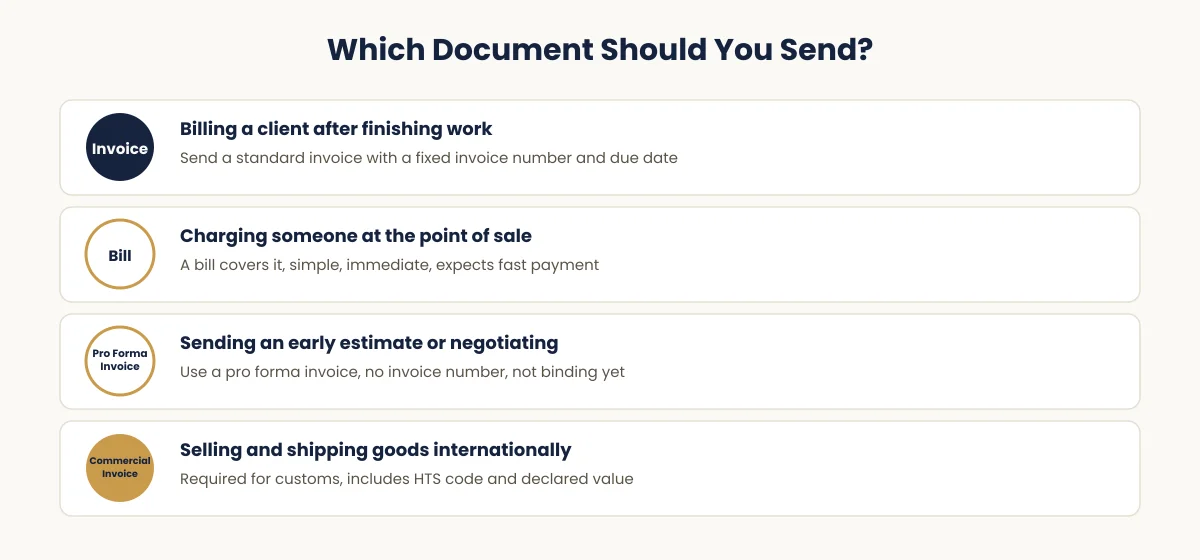
- Sending an early estimate or negotiating a deal? Use a pro forma invoice.
- Selling and shipping goods internationally? Use a commercial invoice.
- Billing a client after finishing work? Use a standard invoice.
- Charging someone at the point of sale? That’s a bill.
A quick way to remember it: pro forma invoices come before a sale, invoices and bills confirm one that already happened, and commercial invoices apply specifically when goods cross a border.
If you’re ever unsure which one applies, ask whether the sale is final and whether goods are shipping internationally. Those two questions usually point you to the right document.
Frequently Asked Questions
Is a pro forma invoice legally binding?
No. It’s a preliminary estimate, not a demand for payment. Buyers are not obligated to pay the amount listed on it.
What is a pro forma invoice used for?
It helps buyers plan costs before committing to a purchase. It’s also used for financing requests, import permits, and letters of credit.
Can a pro forma invoice be used for customs clearance?
Generally, no. Customs authorities require a commercial invoice with declared value and HTS codes to clear a shipment.
What is the difference between a bill and an invoice?
They’re often the same document, viewed differently. Your invoice becomes the buyer’s bill. Bills also tend to be simpler and expect faster payment.
Do FedEx or DHL require a commercial invoice?
For most dutiable international shipments, yes. A pro forma invoice may work for early quotes, but the final shipment needs a commercial invoice.
Can you convert a pro forma invoice into a real invoice?
Yes. Once the sale is confirmed, the same details get reissued as a standard invoice, this time with an invoice number and binding payment terms.
Conclusion
Four documents, four different jobs. An invoice requests payment after work is done. A bill is that same request, seen from the buyer’s side. A pro forma invoice previews costs before anything is final. A commercial invoice locks in the sale and clears customs for international shipments.
Getting these mixed up can delay payment, stall a shipment, or create confusion with a client. Once you know which document fits which stage of a sale, choosing the right one becomes second nature.
Ready to create one yourself? Try our free invoice generator to build a professional invoice, quote, or pro forma style document in minutes, no signup required.