Quote vs Invoice: What’s the Difference and When Should You Use Each?
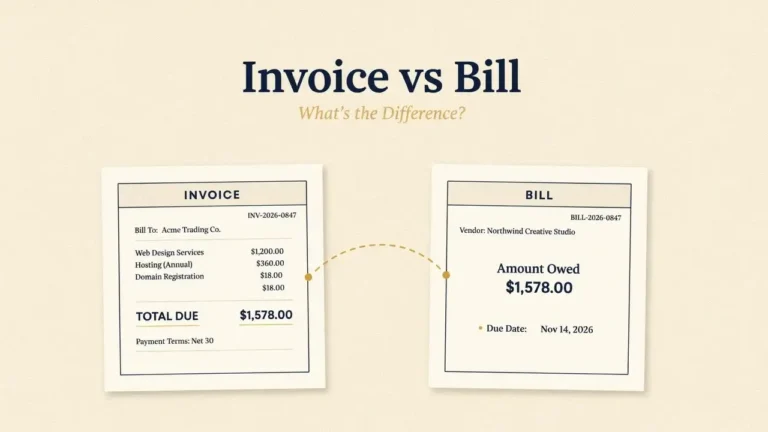
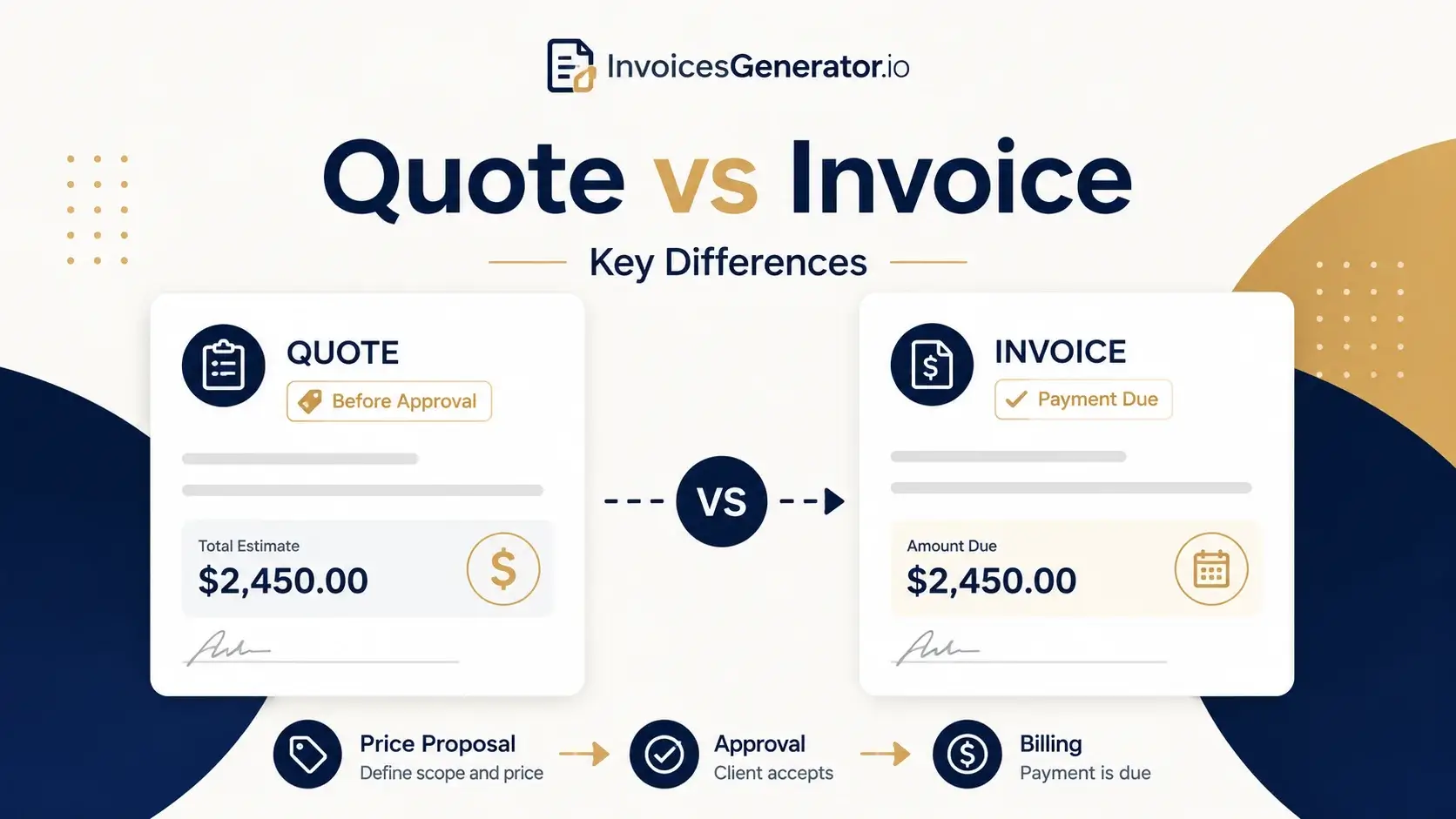
A quote proposes a price. An invoice asks for payment. That single distinction, quote vs invoice, decides which document you send and when.
Businesses usually send quotes before final approval. They send invoices according to the agreed billing schedule.
That does not mean every invoice comes after completed work. Businesses may invoice for deposits, milestones, retainers, recurring services, or finished work.
The easiest rule to remember is simple:
A quote helps agree on the price. An invoice asks for payment.
Quick Answer
| Quote | Invoice |
|---|---|
| Proposes a price | Requests payment |
| Usually comes before approval | Comes when payment becomes due |
| Helps confirm scope and pricing | Records billable charges |
| Customer reviews or accepts it | Customer pays it |
| Often has a validity date | Usually has a due date |
| Uses a quote number | Uses an invoice number |
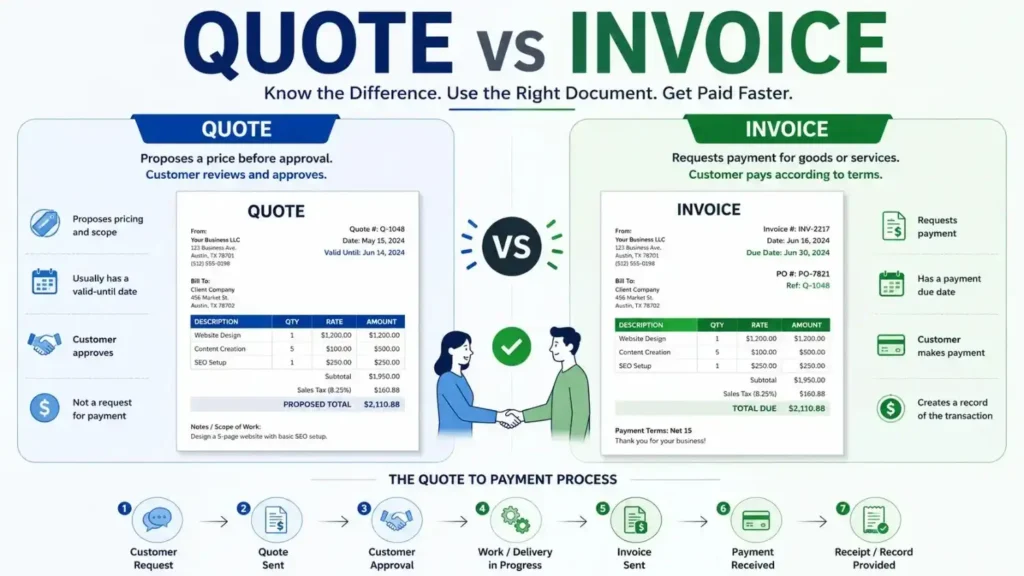
Quote vs Invoice at a Glance
Quotes and invoices can contain many of the same details. Their jobs within a transaction are different.
| Question | Quote | Invoice | Why It Matters |
|---|---|---|---|
| Main purpose | Proposes pricing and terms | Requests payment | Tells customers what action comes next |
| Typical timing | Before final approval | When payment becomes due | Prevents confusion about billing |
| Customer action | Review, accept, reject, or revise | Pay according to terms | Each document has a different goal |
| Payment due? | Usually no | Yes | Separates pricing from billing |
| Price status | Proposed | Billable amount | Changes should be approved before billing |
| Important date | Valid-until date | Due date | Each date serves a different purpose |
| Document number | Quote number | Invoice number | Makes records easier to track |
| Scope | Defines proposed work | Lists billable work | Helps explain what the customer receives |
| Sales tax | May show expected tax | May show applicable tax | Treatment depends on the transaction |
| Accounting role | Pricing and approval record | Billing and financial record | Creates a clearer transaction history |
The main quote vs invoice difference is the customer’s next action. A quote asks for approval, while an invoice asks for payment.
What Is a Quote?
A quote, sometimes called a quotation, sales quote, or price quote, outlines the expected cost of specific goods or services before the customer gives approval.
Businesses commonly use quotes when pricing depends on customer requirements. Contractors, photographers, consultants, designers, and repair companies are common examples.
A useful quote tells the customer more than the final price. It explains what that price covers.
A professional quote may include:
- Business and customer details
- Quote number
- Issue date
- Valid-until date
- Products or services
- Quantities
- Labor and materials
- Unit prices
- Discounts
- Expected sales tax
- Proposed total
- Scope of work
- Deposit requirements
- Terms and conditions
- Acceptance instructions
A validity date can be important when labor, materials, or supplier costs change.
For example, a business might state:
Quote valid for 30 days.
If the customer accepts later, the business can confirm whether the original price still applies.
What Happens After a Quote Is Accepted?
The next step depends on the agreement.
A business may request a deposit, schedule work, order materials, or begin providing the service.
The approved quote should remain available for reference. If the scope changes later, both parties can compare new work against the original agreement.
That approval trail becomes especially useful before final billing.
What Is an Invoice?
An invoice is a document requesting payment for billable goods or services.
It tells the customer what they owe, what the charges cover, and when payment becomes due.
Invoices do not only appear after completed work.
A business might invoice for:
- An upfront deposit
- A project milestone
- A monthly retainer
- Recurring services
- Delivered products
- Completed work
- A final project balance
The agreed payment arrangement determines the correct billing point.
What Does an Invoice Usually Include?
Most professional invoices contain:
- Business details
- Customer billing details
- Unique invoice number
- Invoice date
- Payment due date
- Goods or services provided
- Quantity and unit price
- Subtotal
- Discounts
- Applicable sales tax
- Approved additional charges
- Total amount due
- Payment terms
- Payment instructions
- Purchase order number, when relevant
- Related quote reference, when useful
Clear line items help customers understand their charges. They also make bookkeeping and payment reconciliation easier.
Once your price and billable work are agreed, you can use our free invoice generator to prepare the invoice.
Quote vs Invoice: 7 Differences That Matter in Real Business
Understanding the definitions is useful. Understanding how the documents behave during an actual transaction matters more.
1. A Quote Proposes, an Invoice Bills
A quote presents pricing before the customer makes a final decision. The customer may accept it, reject it, or request changes.
An invoice has another purpose. It tells the customer that an agreed amount is now payable.
Think of the customer action:
Quote → Approve
Invoice → Pay
2. Quotes Usually Appear Earlier
Quotes normally appear during the pricing and approval stage. Invoices appear when an agreed billing point arrives. That billing point might occur before, during, or after the work.
For example, a contractor may require a deposit before ordering materials. A consultant may invoice monthly. Another business may invoice after delivery.
The payment agreement determines timing.
3. Quote Pricing Can Change Before Agreement
Customers often request changes before approving a project.
They might change:
- Quantity
- Materials
- Features
- Delivery requirements
- Service level
- Project scope
The business can revise its quote before final approval.
Changes require greater care after approval. Extra charges should be discussed before they unexpectedly appear on an invoice.
4. Quotes Use Validity Dates, Invoices Use Due Dates
These dates answer completely different questions.
A quote validity date answers:
How long is this proposed price available?
An invoice due date answers:
When must this amount be paid?
Common invoice terms include:
- Due upon receipt
- Net 15
- Net 30
- A specific payment date
Keeping these dates distinct makes customer expectations clearer.
5. Quote Numbers and Invoice Numbers Track Different Documents
Each document should remain easy to identify.
For example:
Quote: Q-1048
Invoice: INV-2217
The invoice can reference Q-1048 without using the same number.
One quote may also lead to several invoices.
A $12,000 project might use:
Quote: Q-1055
Deposit invoice: INV-2301
Milestone invoice: INV-2340
Final invoice: INV-2392
Separate numbering makes the transaction easier to follow.
6. Customer Acceptance Matters More for Quotes
A quote often needs customer approval before work proceeds.
Acceptance might happen through:
- Signature
- Email confirmation
- Online approval
- Purchase order
- Another documented agreement
Keeping evidence of important approvals becomes useful when pricing or scope changes later.
The legal effect cannot be decided simply by calling a document a “quote” or “invoice.” The wording, agreement, conduct, and applicable law can all matter.
7. Their Recordkeeping Roles Differ
Quotes mainly support pricing and customer approval.
Invoices support billing and financial records.
The IRS identifies invoices among supporting documents businesses may keep to support entries in their books and tax returns. It also says businesses may generally use a recordkeeping system suited to their needs if it clearly shows income and expenses.
A well-documented transaction might therefore look like:
Quote → Approval → Invoice → Payment → Receipt
How a Quote Becomes an Invoice
The relationship becomes clearer when you view both documents as parts of one transaction.
Original Quote-to-Payment Flow
Customer Request → Quote → Approval → Work or Delivery → Invoice → Payment → Receipt
Here is what happens at each stage.
Customer Request
The customer explains what they need. The business gathers enough information to price the job accurately.
Quote
The business proposes:
- Scope
- Quantity
- Pricing
- Important conditions
- Validity period
The customer can then review the offer.
Approval
The customer accepts the agreed scope and price. If changes are needed, resolve them before moving forward.
Work or Delivery
The business provides the agreed goods or services. The billing arrangement may also require deposits or progress payments during this stage.
Invoice
When payment becomes due, the business issues an invoice. The invoice should reflect approved billable charges and reference related documents when useful.
Payment and Receipt
The customer pays according to the invoice terms. The business records the payment and provides suitable confirmation.
This connected record is far easier to understand than isolated documents.
Can You Change a Quote After It Has Been Accepted?
Yes, but accepted quotes should not be changed without customer agreement.
Once a customer approves pricing and scope, that approval becomes important. Changing major terms afterward can create confusion and billing disputes.
Small administrative corrections may not affect the commercial agreement. Price, quantity, scope, deadlines, or service changes are different.
Those changes should normally receive fresh customer approval.
When a Revised Quote Makes Sense
A revised quote may be useful when:
- The customer requests additional work.
- Product quantities increase or decrease.
- Different materials are selected.
- Project requirements change.
- Delivery requirements become more expensive.
- Important deadlines change.
- The original pricing no longer covers the new scope.
Suppose a contractor receives approval for a $4,000 project. The customer later requests work that adds another $700.
Instead of silently changing the accepted document, the contractor can issue:
Original Quote: Q-1048, $4,000
Revised Quote: Q-1048-R1, $4,700
Final Invoice: INV-2217, $4,700
The revised quote shows exactly where the new price came from.
Should You Delete the Original Quote?
Usually, keeping the original version creates a clearer transaction record.
It lets both parties see:
- What was first proposed
- What the customer originally approved
- What later changed
- When the change happened
- Which revised price received approval
Replacing the old quote without keeping any record can make disputes harder.
How to Handle Changes After Approval
Use a simple process:
- Identify what changed.
- Explain how the change affects pricing.
- Prepare a revised quote when necessary.
- Get customer approval for the new terms.
- Keep both versions with your records.
- Invoice according to the latest approved agreement.
Original Quote Revision Framework
Accepted Quote → Scope Changes → Revised Quote → Customer Approval → Invoice
This process keeps approval separate from final billing. It also gives the invoice a clear supporting record.
Can an Invoice Be Different From the Quote?
Yes. A final invoice can differ from the original quote when something changes during the transaction.
The important issue is whether the change has a clear reason and approval.
Common reasons include:
- Customer-requested extra work
- Increased quantities
- Changed materials
- Added services
- Revised delivery requirements
- Variable costs identified earlier
- Applicable tax changes
- New pricing after an expired quote
Suppose a customer approves a $4,000 renovation.
They later request another room for $800. The contractor explains the cost, and the customer approves it. A $4,800 final invoice now has a documented reason.
Original Scope Change Checklist
Before billing above an approved quote, ask:
- Did the scope actually change?
- Did the customer understand the change?
- Was the extra cost explained?
- Did the customer approve it?
- Is that approval recorded?
- Does the invoice clearly show the extra charge?
If several answers are no, resolve the issue before billing.
The useful principle is:
Original Quote → Change → Approval → Invoice
Do not make the final invoice the first place where customers discover new charges.
What Happens When a Quote Expires?
A quote expiration date shows how long proposed pricing remains available.
After that date, the business may need to review the price. This does not always mean the customer must start again.
The business can first confirm whether the original terms still work.
Why Quotes Have Expiration Dates
Business costs can change after pricing is prepared.
Common reasons include:
- Material price changes
- Supplier price increases
- Labor cost changes
- Shipping changes
- Product availability
- Scheduling constraints
- Seasonal pricing
A validity period protects the business from honoring outdated pricing indefinitely.
For example:
Quote issued: August 1
Valid until: August 31
If the customer accepts on September 10, pricing may need confirmation.
What Should You Do After Expiration?
Before accepting an expired quote, review the important details.
Check:
- Current product prices
- Current material costs
- Labor rates
- Supplier availability
- Delivery costs
- Project schedule
- Applicable taxes or fees
If nothing changed, the business may confirm the original price. If costs changed, prepare an updated quote before proceeding.
Should an Expired Quote Keep the Same Number?
There is no single numbering method every business must use. The important point is keeping the document history understandable.
For example:
Original Quote: Q-1052
Updated Quote: Q-1052-R1
Another business might create a completely new quote number. Either approach can work when records remain clear and consistent.
Original Expired Quote Decision Framework
Is the quote still valid?
Yes → Customer can approve the current terms.
No → Review price, scope, availability, and timing.
Then:
No changes → Confirm the original terms.
Changes found → Issue an updated quote and get approval.
An expired quote should not automatically become an invoice. First confirm what the customer is actually agreeing to pay.
Is a Quote Legally Binding in the United States?
A quote is not automatically binding simply because the document says “quote.”
Its legal effect can depend on its wording, the customer’s acceptance, the conduct of both parties, and applicable state law.
For transactions involving goods, Article 2 of the Uniform Commercial Code may also matter. UCC §2-206 provides that an offer can generally invite acceptance through a reasonable manner or medium unless the language or circumstances indicate otherwise.
That means a signature is not necessarily the only fact that matters.
Depending on the transaction, evidence could include:
- Signed terms
- Email acceptance
- Purchase orders
- Performance
- Delivery
- Other conduct between the parties
Is an Invoice Legally Binding?
Calling an invoice “legally binding” is also too broad.
An invoice normally documents and requests payment connected to an underlying transaction.
That transaction might be supported by:
- An accepted quote
- Contract
- Purchase order
- Email agreement
- Completed work
- Delivered goods
- Other evidence of agreement
For sales of goods, UCC §2-207 also addresses written confirmations and additional or different terms. New terms appearing in paperwork do not automatically become part of every agreement.
For example, adding an unexpected fee only when issuing the invoice does not necessarily prove that the customer agreed to it.
Useful insight: The approval trail often matters more than the document label.
Businesses dealing with significant contract disputes should get advice for their state and situation.
Quote vs Invoice Example
Consider a small web design business. A client requests a five-page website.
The designer sends this quote:
- Website design: $1,500
- Setup service: $150
- Proposed total: $1,650
- Valid for 14 days
The client accepts.
During the project, they request another booking page. The designer quotes another $200, and the client approves it in writing.
The final invoice contains:
- Website design: $1,500
- Setup service: $150
- Additional booking page: $200
- Total due: $1,850
Original Transaction Example
| Stage | Record | Amount | Customer Action |
|---|---|---|---|
| Initial pricing | Quote Q-1048 | $1,650 | Approves |
| Added work | Written approval | $200 | Approves |
| Final billing | Invoice INV-2217 | $1,850 | Pays |
This quote vs invoice example shows why both totals do not always need to match. What matters is whether the final charges connect to approved work.
Should You Send a Quote or an Invoice?
Instead of memorizing definitions, ask what the customer needs to do next.
Original Decision Framework
Has the customer approved the price and scope?
No → Send a quote.
The customer still needs to review the proposed transaction.
Yes → Is payment due now?
No → Keep the approval or agreement on record.
Yes → Send an invoice.
Now add one final question:
Did the scope or price change?
Yes → Document and approve the change before billing it.
Quick Decision Table
| Situation | Best Next Document |
|---|---|
| Customer asks what something costs | Quote |
| Custom work still needs approval | Quote |
| Project scope remains undecided | Quote |
| Deposit becomes due | Invoice |
| Project milestone becomes payable | Invoice |
| Completed work needs billing | Invoice |
| Monthly retainer becomes due | Invoice |
| Customer requests extra work | Revised quote or written approval |
| Buyer issues an approved PO | Invoice at the agreed billing point |
When You May Not Need a Quote
Not every transaction needs one.
A separate quote may be unnecessary when:
- Pricing is fixed and published.
- An existing contract sets the price.
- A recurring agreement already exists.
- The customer uses a standard subscription.
- An agreed hourly rate already applies.
- A purchase order confirms the purchase.
The goal is clear agreement, not unnecessary paperwork.
Quote, Purchase Order, Estimate, and Invoice
Several related documents appear during business transactions.
Understanding where they fit prevents terminology from becoming confusing.
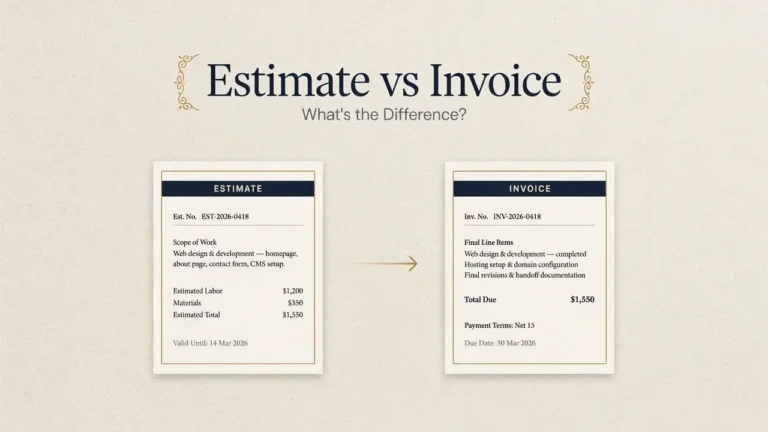
Estimate vs Quote
An estimate gives an approximate expected cost.
A quote usually presents more defined pricing for stated work.
An invoice requests payment.
A simple comparison is:
| Document | Question It Answers |
|---|---|
| Estimate | What will this probably cost? |
| Quote | What will this defined work cost? |
| Invoice | What amount is now payable? |
Exact legal effects can still depend on wording and circumstances.
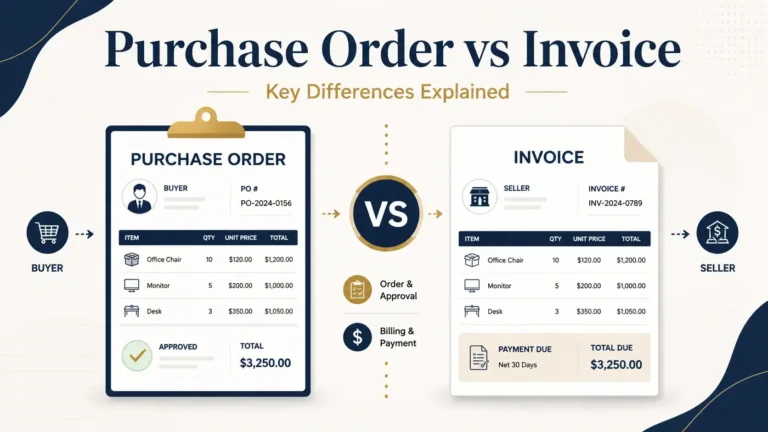
Purchase Order vs Quote vs Invoice
A purchase order comes from the buyer rather than the seller.
A common B2B sequence is:
Seller Quote → Buyer Purchase Order → Delivery → Seller Invoice → Payment
Each document has its own purpose.
Quote: Seller proposes price.
Purchase order: Buyer confirms an authorized purchase.
Invoice: Seller requests payment.
For example:
Quote: Q-1048
PO: PO-7821
Invoice: INV-2217
Referencing these numbers makes larger transactions easier to reconcile.
What About a Tax Invoice?
“Tax invoice” terminology appears more frequently in countries using VAT or GST systems.
U.S. businesses normally deal with applicable state and local sales taxes instead.
A quote may show expected sales tax. An invoice may show the tax charged on the final transaction.
Businesses should follow rules that apply to their state, product or service, and customer location rather than copying foreign VAT or GST requirements.
Common Quote and Invoice Mistakes
A few mistakes cause most pricing and billing confusion.
Sending Vague Quotes
“Website work: $2,000” leaves room for disagreement.
A clearer description might state:
Five-page website design, responsive layout, and contact form: $2,000.
Better descriptions create clearer expectations.
Adding Charges Without Approval
Do not make the final invoice the first place customers see major extra costs.
Explain scope changes before providing additional billable work.
Confusing Validity Dates With Due Dates
A quote validity date limits proposed pricing.
An invoice due date tells the customer when payment is expected.
They are not interchangeable.
Reusing the Same Document Number
Quotes and invoices should remain separately identifiable.
Use systems such as:
Q-1050
and:
INV-2308
The invoice can still reference the related quote.
Assuming Every Invoice Follows Completed Work
Deposits, retainers, milestones, and recurring billing can all require invoices earlier.
Follow the agreed payment schedule.
Copying Foreign Invoice Rules
U.S. businesses should be cautious with articles built around VAT, GST, or another country’s invoice requirements.
Tax and legal requirements can differ by jurisdiction.
Quote vs Invoice: The Simple Rule to Remember
The quote vs invoice difference becomes much easier when you focus on the customer’s next action.
A quote helps establish pricing and scope.
An invoice requests payment when agreed charges become due.
A typical transaction may look like:
Quote → Approval → Work or Delivery → Invoice → Payment → Receipt
Some transactions add purchase orders, deposits, milestones, or approved changes.
Before sending a document, ask:
Does the customer still need to approve the price?
If yes, send a quote.
Is an approved amount now payable?
If yes, send an invoice.
Once you reach that billing stage, use our free invoice generator to create a clear invoice for your customer.
Is a quote the same as an invoice?
No. A quote presents proposed pricing before final customer approval.
An invoice requests payment when an agreed amount becomes due. Both documents may list similar products, services, prices, and customer details.
Their purposes remain different because they appear at different transaction stages.
Do you send a quote before an invoice?
Usually, but not every transaction requires a quote first.
Custom projects often begin with a quote because pricing needs approval. An invoice follows when the agreed payment point arrives.
Recurring services, fixed prices, contracts, or purchase orders may skip quoting entirely.
Can I use a quote as an invoice?
It is better to keep quotes and invoices as separate documents.
A quote normally asks the customer to approve pricing and scope. An invoice should clearly identify the amount due and payment deadline.
Once pricing receives approval, create a separate invoice for billing.
Can an invoice be higher than the original quote?
Yes, but there should be a clear reason for the increase.
Extra services, changed quantities, additional materials, or approved scope changes can increase costs. Tell the customer about those charges before final billing.
Keeping written approval creates a clearer record if questions arise later.
Is a signed quote legally binding?
A signature can provide strong evidence that the customer accepted terms. However, legal effect depends on the quote, circumstances, and applicable law.
Other forms of acceptance may also matter in some transactions.
Businesses should keep important agreements and later changes clearly documented.
Can you invoice someone without sending a quote first?
Yes. A quote is not required for every business transaction.
You may invoice directly when pricing and payment terms already exist. Common examples include retainers, recurring services, contracts, and approved purchase orders.
Clear agreement about charges should still exist before requesting payment.
Does a quote need a different number from an invoice?
Using separate numbering systems is generally clearer for business records.
For example, a quote might use Q-1050. Its related invoice might use INV-2308.
The invoice can reference Q-1050 without using the same document number.
What comes after a customer accepts a quote?
The next step depends on the agreed payment and delivery terms.
You might request a deposit, begin work, deliver products, or schedule services. When an agreed payment point arrives, issue the corresponding invoice.
After payment, provide appropriate confirmation or a receipt when needed.
Conclusion
The quote vs invoice difference is easiest to understand by looking at the customer’s next step.
A quote presents proposed pricing and scope for approval. An invoice requests payment when an agreed amount becomes due. The two documents may contain similar details, but they serve different stages of the transaction.
Clear quotes, written approvals, and accurate invoices also help prevent disputes. If pricing or scope changes, document the change before final billing.
For most businesses, a simple process works well:
Quote → Approval → Work or Delivery → Invoice → Payment
Once the price and billable work are confirmed, you can use our free invoice generator to create a professional invoice online.