PO Number vs Invoice Number: What’s the Difference (With Example)
A PO number and an invoice number look similar, but they do different jobs. The PO number vs invoice number mix-up causes billing delays, payment confusion, and rejected invoices every day. One is created by the buyer, the other by the seller. One starts the order, the other collects the payment.
If you have ever wondered what a PO number on an invoice actually means, this clears it up. You get the difference, where each number goes, and a real invoice showing both together.
What Is a PO Number?
A PO number is a unique code assigned to a purchase order. The buyer creates it when they decide to order goods or services. It stays tied to that order from the first request to the final payment.
PO stands for purchase order. The number lets both sides track the order, confirm delivery, and check it against the invoice later.
A PO number is usually alphanumeric, and the format varies by company. A simple one looks like PO-001. A structured one looks like PO-2026-1234, where 2026 is the year and 1234 is the order sequence. Some companies add a department code, like PO-2026-1234-IT.
The buyer owns this number. No two purchase orders in their system share it.
What Is an Invoice Number?
An invoice number is a unique code the seller assigns to an invoice. It identifies that one bill and helps track payment against it.
Where the PO number starts the order, the invoice number closes it. The seller creates it when they send the invoice requesting payment.
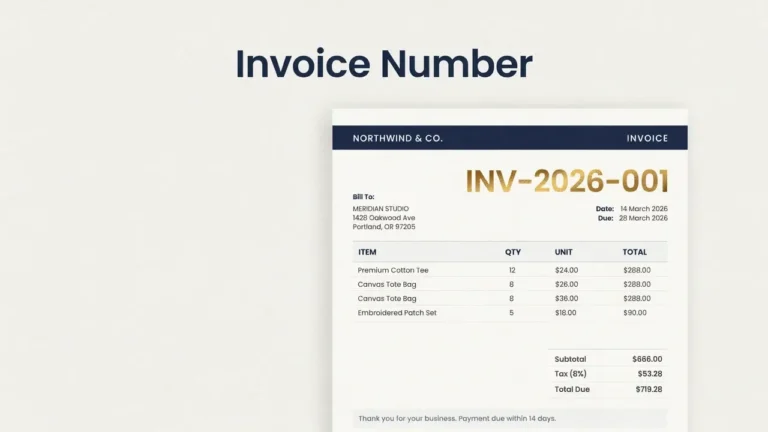
The format is up to the seller, often sequential like INV-0042 or 2026-0001. If you want the full breakdown of formats and rules, the invoice number guide covers it in detail.
PO Number vs Invoice Number: Key Differences
The two numbers sit on different documents, come from different people, and serve different purposes. Here is the side-by-side.
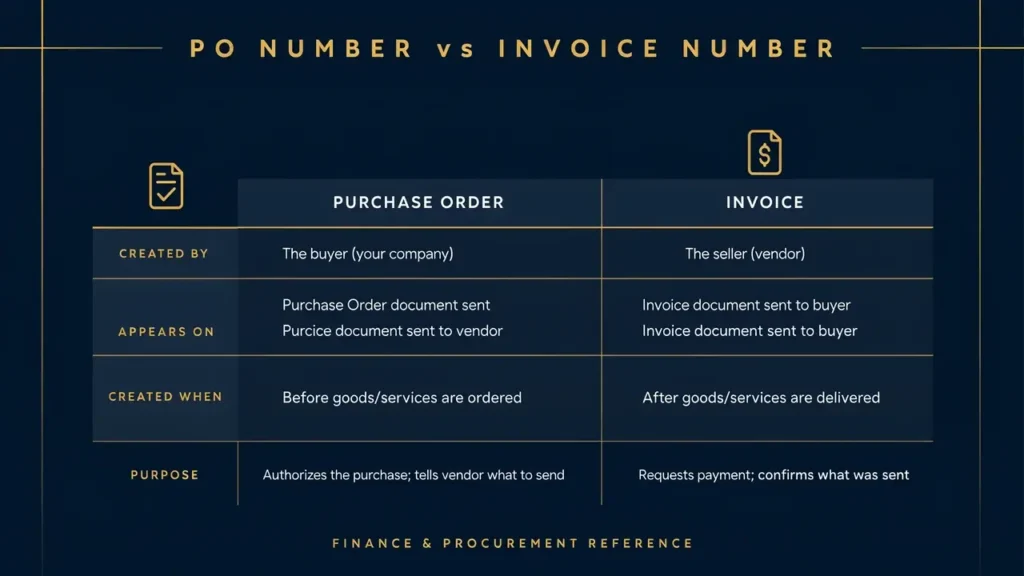
| Aspect | PO Number | Invoice Number |
|---|---|---|
| Created by | The buyer | The seller |
| Appears on | Purchase order (and often the invoice) | Invoice only |
| Created when | Before the order is fulfilled | After, when billing |
| Purpose | Authorize and track the order | Request and track payment |
| Owned by | The buyer | The seller |
The simplest way to remember it: the PO number opens the transaction, the invoice number completes it. One authorizes the purchase, the other asks to be paid for it.
This is a number-level difference. If you want the full comparison of the two documents themselves, see purchase order vs invoice.
Can Both Appear on the Same Invoice?
Yes, and they often do. A single invoice usually carries its own invoice number plus the buyer’s PO number. The two are not in conflict. They work together.
The invoice number identifies the bill. The PO number links that bill back to the order the buyer approved. Together they create a clear paper trail from order to payment.
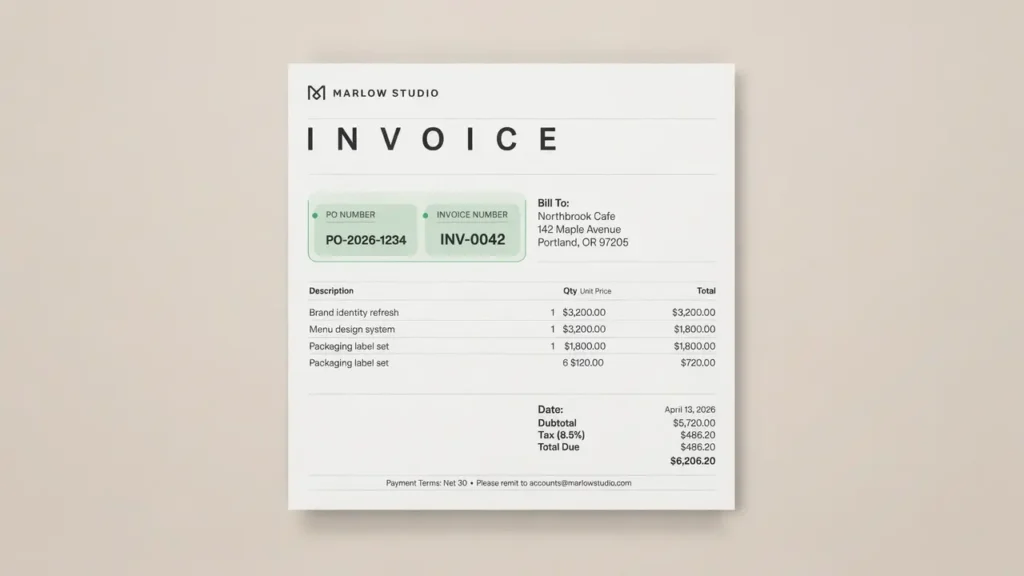
Here is what both look like on one invoice.
Sara runs Marlow Studio. A client, Northbrook Cafe, sends her a purchase order before the job starts. Her invoice ends up carrying two numbers:
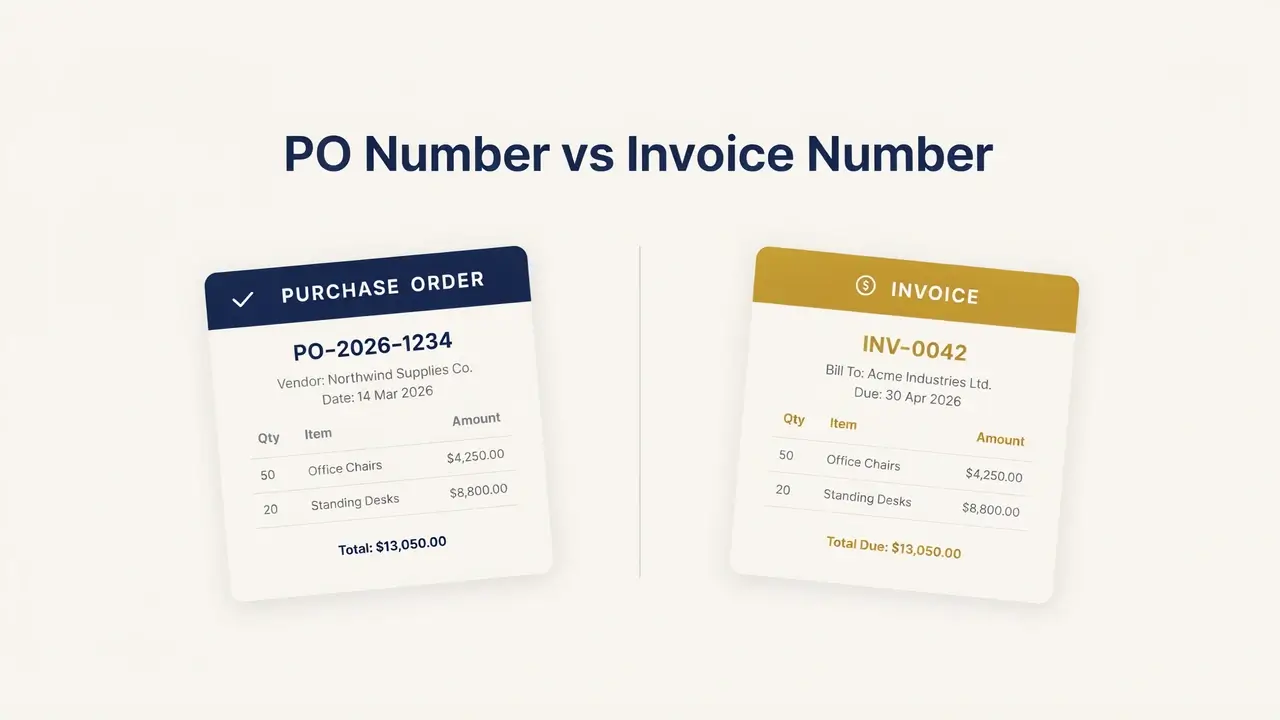
- PO Number: PO-2026-1234 (created by Northbrook Cafe, the buyer)
- Invoice Number: INV-0042 (created by Sara, the seller)
When Northbrook’s finance team receives the invoice, they match PO-2026-1234 to the order they approved. The amounts line up, so they release payment. Sara tracks the same job under INV-0042 in her own records.
One order, two numbers, no confusion.
Where Does the PO Number Go on an Invoice?
The PO number belongs near the top of the invoice, usually in the billing or reference section. It should be easy to spot.
Most invoice layouts have a field for it, labeled “PO Number,” “Purchase Order Number,” or “Reference.” You enter the number the buyer gave you, exactly as they wrote it.
Keep it close to your invoice number and the invoice date. That way the buyer’s accounts team can match everything at a glance.
Why the PO Number Matters on an Invoice
For business clients, the PO number is often what gets your invoice paid on time. It connects your bill to an order their system already approved.
- Invoice matching. The PO number lets the buyer match your invoice to the original order in seconds.
- Three-way matching. Many companies compare the purchase order, the delivery receipt, and the invoice before paying. The PO number ties all three together.
- Fewer disputes. Matching the invoice to the PO catches wrong prices, quantities, or charges before payment.
- Faster approval. An invoice with a valid PO number moves through approval without extra questions.
Many organizations run a strict “no PO, no pay” rule. If a required PO number is missing or wrong, they return the invoice unpaid instead of chasing you for it. Adding the correct number upfront avoids that delay.
PO Invoice vs Non-PO Invoice
Not every invoice has a PO number behind it. That is the difference between a PO invoice and a non-PO invoice.
A PO invoice bills against a purchase order. The buyer approved the order first, so the invoice quotes that PO number. These are common in B2B work and larger companies.
A non-PO invoice has no purchase order behind it. The sale happened without a formal order first, so there is no PO number to reference. These are normal for smaller jobs, quick services, and most freelance work.
Neither is wrong. The only difference is whether a purchase order started the transaction.
A Client Asked Me for a PO Number. What Do I Do?
This trips up a lot of freelancers and small businesses. A client says they need a PO number on your invoice, and you are not sure where to get one.
Here is the key point: you cannot create the PO number yourself. It belongs to the buyer. Making one up, or using your own invoice number in its place, will get your invoice rejected.
What to do instead:
- Ask the client for it. Request the PO number from their finance or procurement team.
- Wait until you have it. If they run a “no PO, no pay” policy, do not send the invoice without it.
- Add it to your invoice. Enter the number in the PO or reference field, exactly as given.
- Keep your own invoice number too. Both numbers appear on the invoice. Yours identifies the bill, theirs links it to the order.
When you build the bill, the PO field sits alongside the other standard details covered in how to write an invoice. A free invoice generator gives you a reference field for the PO number, so both sit on the invoice in the right place.
PO Number vs Order Number vs Invoice Number
A third reference adds to the confusion: the sales order number. One job can carry all three at once, so it helps to keep them straight.
- PO number. Created by the buyer to authorize and track the purchase.
- Sales order (SO) number. Created by the seller internally to track fulfilling that order.
- Invoice number. Created by the seller to bill for the completed order.
So an order number is not the same as an invoice number. When a client asks for “the PO number,” your invoice number is not a substitute, and neither is your sales order number. Each points to a different step in the same transaction.
Frequently Asked Questions
Is a PO number the same as an invoice number?
No. The buyer creates the PO number to authorize an order. The seller creates the invoice number to request payment. An invoice often shows both.
Does an invoice need a PO number?
Only if the buyer uses purchase orders. Many B2B clients require it. For most freelance and small jobs with no purchase order, it is not needed.
Who creates the PO number?
The buyer. They assign it when they issue the purchase order, before any invoice exists.
Can I use my invoice number as a PO number?
No. They are separate references from different parties. If a client needs a PO number, request it from them.
How many digits is a PO number?
There is no fixed length. It varies by company, from a short sequential code to a longer format with year and department segments.
What happens if the PO number is wrong on an invoice?
The buyer’s system may flag it as an exception and hold payment. Confirm the number with the client to avoid delays.
Is a PO number a contract?
The PO number itself is not a contract. The purchase order it belongs to becomes a binding agreement once the seller accepts it.
Final Word on PO and Invoice Numbers
The PO number vs invoice number difference comes down to who creates it and why. The buyer issues the PO number to authorize an order. The seller issues the invoice number to collect payment. Both can sit on the same invoice, and together they keep the transaction traceable from start to finish.
If a client asks for a PO number, request it and add it to your bill. When you build that invoice, our free invoice generator gives you a clean reference field for it, so your invoice number and the buyer’s PO number both land in the right place.