Invoice Number: What It Is, How to Create One, and Examples
An invoice number is the unique code you assign to every invoice you send. It keeps your billing organized, helps clients reference payments, and makes your records easy to search. Pick a sensible invoice number format once, and the whole process runs on autopilot.
Most freelancers and small businesses overthink this. The number itself does not need to be clever. It needs to be unique, consistent, and easy to trace. The rest is just choosing a system that fits how you work.
Below you get clear formats, real examples, the rules that actually matter, and the mistakes worth avoiding.
What Is an Invoice Number?
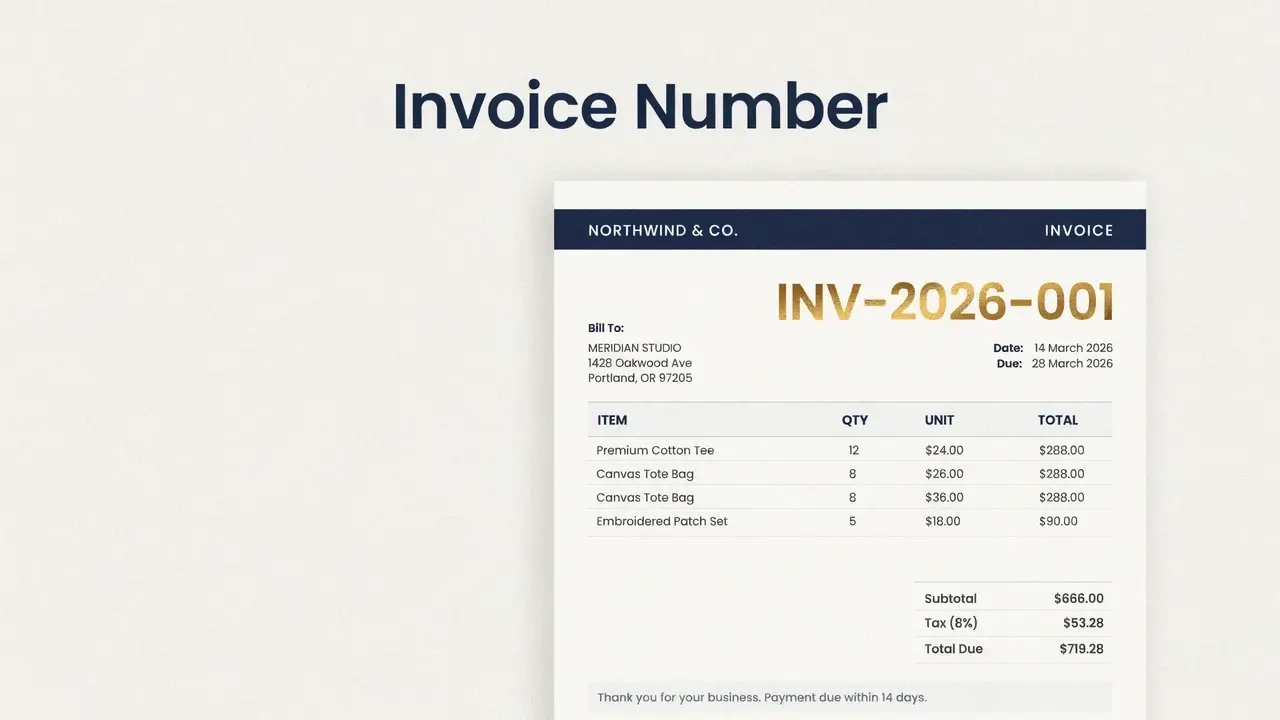
An invoice number is a unique identifier printed on each invoice. No two of your invoices should ever carry the same one. It usually sits near the top of the document, close to the invoice date and the client’s details.
People also call it an invoice ID or a reference number. Whatever the label, its job is the same: give every bill a distinct code so you can find it later.
A number can be purely numeric, like 1001, or mixed with letters, like INV-2026-001. Both are valid. What matters is that the code points to one invoice and one only.
When a client emails asking about “that invoice from March,” the number is how you find it in seconds. It is also the reference your accounting software, your bank, and your tax records all rely on.
Why Invoice Numbers Matter
A good numbering system does more than look tidy. It affects how fast you get paid and how smoothly tax season goes.
- Payment tracking. A unique number lets you match payments to invoices without guessing.
- Faster follow-ups. Chasing a late payment is easier when you can quote an exact reference.
- Clean records. Sequential numbers reveal gaps or duplicates at a glance.
- Audit readiness. Organized, traceable invoices hold up if your books are ever reviewed.
- Professionalism. A structured number signals an established business, not a first-timer.
Skip the system and these small problems pile up. Two invoices with the same number confuse clients and your own bookkeeping. A missing number makes a payment hard to trace months later.
If you are still setting up your billing, the number fits into the wider set of fields every invoice needs, which the step-by-step on how to write an invoice walks through in order.
Invoice Number Formats (With Examples)
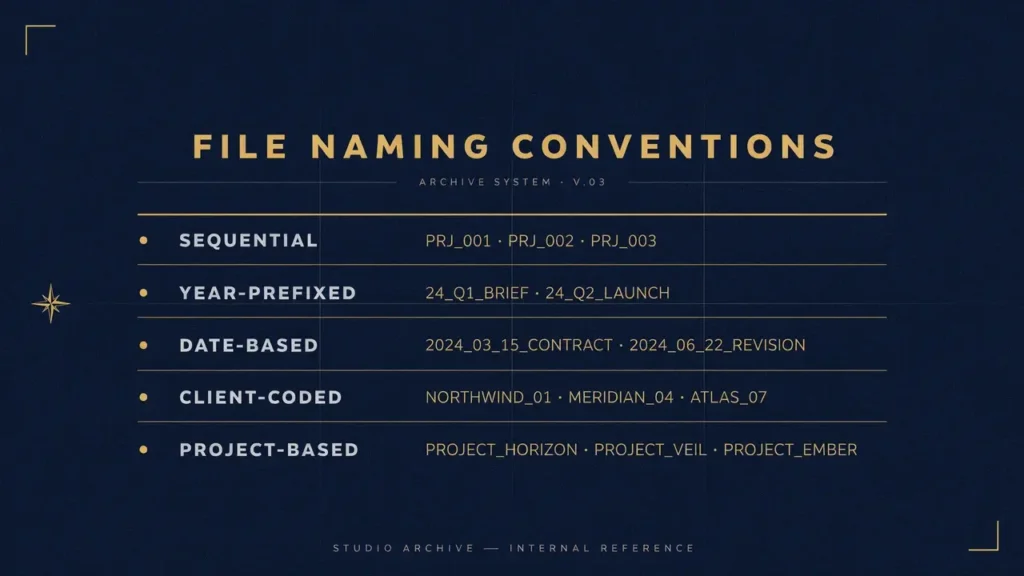
There is no single correct format. The right one depends on how many clients you have and how many invoices you send. Here are the five systems most businesses use.
| Format | Example | Best for |
|---|---|---|
| Sequential | 0001, 0002, 0003 | Solo freelancers with low invoice volume |
| Year-prefixed | 2026-0001, 2026-0002 | Most freelancers and small businesses |
| Date-based | 20260315-001 | High-volume or recurring billers |
| Client-coded | ACME-001, ACME-002 | Service businesses with repeat clients |
| Project-based | WEB-2026-001 | Agencies and contractors billing by project |
Sequential is the simplest. Each new invoice takes the next number in line. It works well until you need to tell clients or dates apart at a glance.
Year-prefixed adds the year and resets each January. So 2026-0001 is your first invoice of 2026. This is the format that fits most small businesses, and it makes year-end filing easier.
Date-based builds the full date into the number. It suits businesses sending many invoices, though it can get long for everyday use.
Client-coded starts with a short client tag. ACME-001 instantly tells you which client an invoice belongs to, which helps when you review their history.
Project-based ties the number to a specific job. Useful when one client runs several separate projects at once.
You can also combine these. A format like 2026-ACME-001 carries the year, the client, and the sequence in one code. More detail, but a longer number to type and read.
How to Create an Invoice Number, Step by Step
Setting up your system takes a few minutes. Do it once, then follow it every time.
- Pick a format. Choose from the five above based on your client count and volume. When unsure, year-prefixed sequential fits most people.
- Choose a starting number. Avoid starting at 1. A first invoice reading 0001 tells clients you are brand new. Begin at 1001 or 2026-0001 instead.
- Set your digit length. Use enough digits for your expected volume. A four-digit sequence covers up to 9,999 invoices before you need to adjust.
- Apply it consistently. Every invoice follows the same pattern. Do not mix INV-1 and INV-001 in the same sequence.
- Write the system down. Keep a one-page note of your format, when it resets, and how you handle voids. This keeps you consistent as you get busier.
Once the rules are set, the next number is always obvious. No guessing, no duplicates.
A Year in One Freelancer’s Numbering
An example makes the system click. Here is how a freelance designer runs one clean sequence across a year.
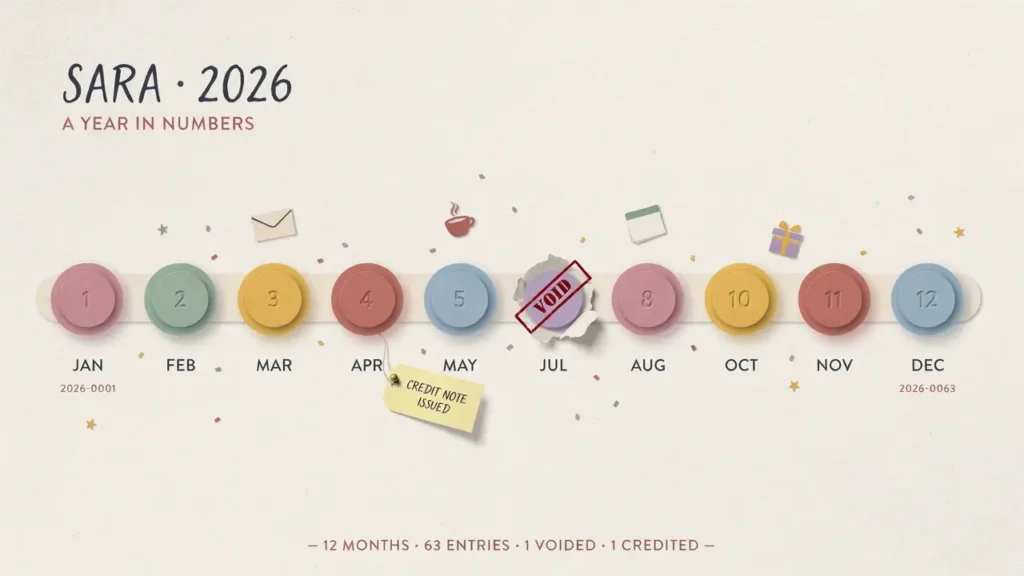
Sara runs Marlow Studio. She picks year-prefixed sequential and starts in January.
- January: First job of the year. Invoice 2026-0001.
- February: Two invoices. 2026-0002 and 2026-0003.
- March: A client cancels a project after she sends 2026-0007. She voids it, keeps the record, and her next invoice is 2026-0008. She does not reuse 0007.
- June: A returning client needs a refund. She issues a credit note as CN-2026-0019, linked to the original invoice.
- December: Her last invoice of the year is 2026-0063.
When a client calls in November about “the invoice from March,” Sara searches 2026, scans to March, and finds 2026-0006 in seconds. The logo project.
Come January, she resets. Her first invoice of the new year is 2027-0001. The old year stays intact in her records, and the new sequence starts clean.
One format, applied all year. That is the whole trick.
Invoice Number Rules You Should Not Break
A few rules keep any system reliable, whichever format you choose.
- Every number is unique. No two invoices share a number, ever. This is the one rule with no exceptions.
- Never reuse a number. If you cancel an invoice, its number retires with it. Do not hand it to a new invoice.
- Keep the sequence in order. Invoice 1043 should come after 1042 in time. Out-of-order numbers confuse clients and your books.
- Stay consistent. Once you pick a format, stick to it. Switching mid-year creates gaps that look like errors.
- Do not leave unexplained gaps. A missing number should always trace back to a void you recorded, not a mystery.
Break these and your records get harder to trust. Follow them and your numbering quietly does its job in the background.
Handling Voided Invoices and Credit Notes
Cancelled invoices trip up a lot of people. The fix is simple once you know the rule.
When you void an invoice, keep it on record and mark it void. Do not delete it, and do not give its number to another invoice. Deleting it leaves a gap that looks like a missing document during a review.
Say you send invoice 2026-0042, then the job falls through. You mark 2026-0042 as void, keep it in your files, and your next invoice is 2026-0043. The sequence stays unbroken.
Credit notes work a little differently. A credit note reverses or reduces an invoice you already sent, often for a refund or a correction. Give it its own sequence with a clear prefix, like CN-2026-001, and reference the original invoice it relates to.
Keeping credit notes on a separate track means they never get mistaken for new invoices. Your invoice sequence stays clean, and the link between the two is easy to follow.
Keep Quotes and Proformas on a Separate Sequence
Your invoice numbers should cover invoices only. Other documents need their own sequences.
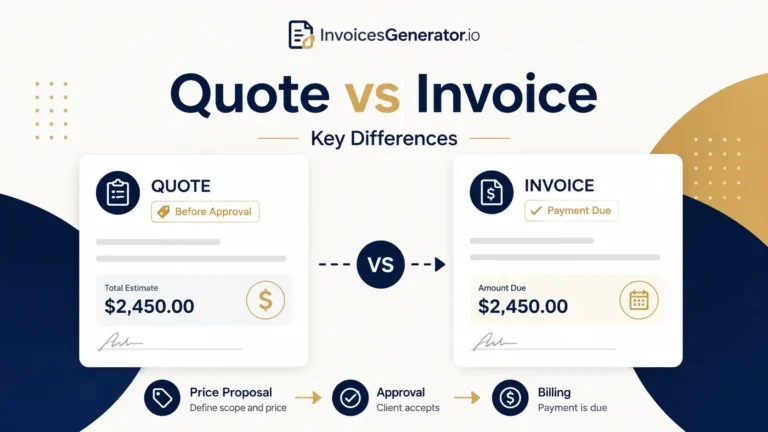
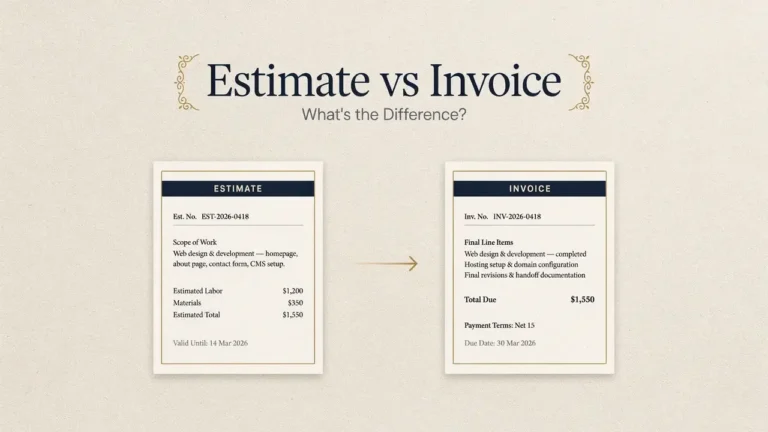
A quote proposes a price before the work is agreed. If a quote shares the same number series as your invoices, the two blur together in your records. Give quotes their own prefix, like EST-001 or QT-001. The difference between the two documents is covered in quote vs invoice.
A proforma invoice is a preliminary bill sent before a sale is final. It also belongs on its own sequence, often with a PF- prefix, so it is never counted as a real invoice. How it differs from a standard invoice is explained in proforma invoice vs invoice.
The rule is the same across all of them. Each document type gets its own series, and nothing crosses over. That way a quote can never be mistaken for a bill, and your invoice numbers stay reserved for actual invoices.
Is a Specific Invoice Number Legally Required?
This depends entirely on where your business operates, and most online guides get it wrong.
In the United States, there is no federal law that dictates an invoice number format. The IRS does not mandate a specific numbering system or even require a formal invoice for every transaction. What it requires is that you keep supporting records that clearly show your income and expenses. IRS Publication 583 and Publication 334 cover these recordkeeping standards.
So in the US, unique sequential numbering is best practice, not a legal format rule. You keep clean numbers because it makes audits and bookkeeping easier, not because a regulation forces a particular style.
Other countries are stricter. The UK under HMRC, the EU under the VAT Directive, and Australia under the ATO all require invoices to carry a unique, sequential identifier by law. If you bill clients in these regions, sequential numbering is not optional.
The practical takeaway is the same everywhere. Keep every invoice number unique, keep the sequence clean, and you satisfy both the strict rules abroad and the recordkeeping expectations at home. When in doubt about your specific situation, confirm with your accountant.
Common Invoice Numbering Mistakes
Most numbering problems trace back to a handful of avoidable errors.
- Starting at 1. Invoice 0001 signals a brand-new business. Start at 1001 or a year-prefixed number instead.
- Reusing a voided number. Once a number is used, it is gone. Reassigning it creates duplicates in your records.
- Mixing formats. INV-1 and INV-001 in the same sequence sort incorrectly and cause confusion.
- Numbering by date alone. Two jobs on the same day collide. Always add a sequential counter.
- Deleting cancelled invoices. This leaves unexplained gaps. Mark them void and keep them on file.
- Switching systems mid-year. Pick a format and hold it until a natural reset point, like January.
Each of these is easy to avoid once your system is written down and applied the same way every time.
Manual vs Automatic Invoice Numbering
You can assign numbers yourself or let a tool handle it. Both work, but they suit different situations.
Doing it manually gives you full control. You track the last number used, usually in a spreadsheet, and type the next one each time. This is fine at low volume, but the risk of a duplicate or a skipped number grows as you get busier.
Automatic numbering removes that risk. The tool remembers the last number and assigns the next one for you. No tracking, no duplicates, no mental math.
Our free invoice generator assigns a number to each invoice as you build it, so the sequence stays consistent without a spreadsheet. You can edit the starting number to match the system you already use. The same applies when you send a receipt or a quote, each kept on its own sequence.
Frequently Asked Questions
What should my first invoice number be?
Avoid starting at 1. A number like 1001 or 2026-0001 looks more established and leaves room to grow.
How many digits should an invoice number have?
Enough for your expected volume. Four digits cover up to 9,999 invoices, which suits most small businesses for years.
Can an invoice number have letters?
Yes. Alphanumeric codes like INV-2026-001 or ACME-001 are common and valid. The only rule is that each stays unique.
Do invoice numbers have to be sequential?
In the US they do not legally have to be, but sequential order is strongly recommended. In the UK, EU, and Australia, it is required by law.
Is an invoice number the same as an order number?
No. The seller creates the invoice number to request payment. The order or PO number comes from the buyer when they place an order. The purchase order vs invoice breakdown explains how the two connect.
Is an invoice number the same as a bill number?
For most purposes, yes. A bill and an invoice are the same document seen from two sides, so the number is shared. The invoice vs bill comparison covers the difference in full.
Where is the invoice number found?
It usually sits near the top of the invoice, close to the invoice date and the client’s details.
Final Word on Invoice Numbers
An invoice number is a small detail that keeps your whole billing system in order. Pick one format, start above 1, keep every number unique, and never reuse a cancelled one. That is all it takes to stay organized and audit-ready.
If you would rather not track numbers by hand, our invoice generator assigns them automatically and lets you set your own starting point. Choose your system once, and your numbering runs quietly in the background from the first invoice to the last.