What to Include on an Invoice: Requirements, Checklist and Examples
Knowing what to include on an invoice is essential for getting paid accurately and on time. Whether you’re a freelancer, contractor, consultant, or small business owner, a professional invoice should clearly explain who is requesting payment, what the customer is being charged for, how much is owed, and when payment is expected.
Most invoices include the seller’s details, customer information, a unique invoice number, relevant dates, descriptions of products or services, itemized charges, applicable taxes, and payment instructions.
However, invoice requirements aren’t identical everywhere. Some details are standard business practices, while others are legally required depending on your country, tax registration, and the type of transaction.
This guide explains what needs to be on an invoice, shows a complete example, and provides a practical checklist to review before sending your next bill.
What Should an Invoice Include? Quick Checklist
A standard business invoice should include the following information:
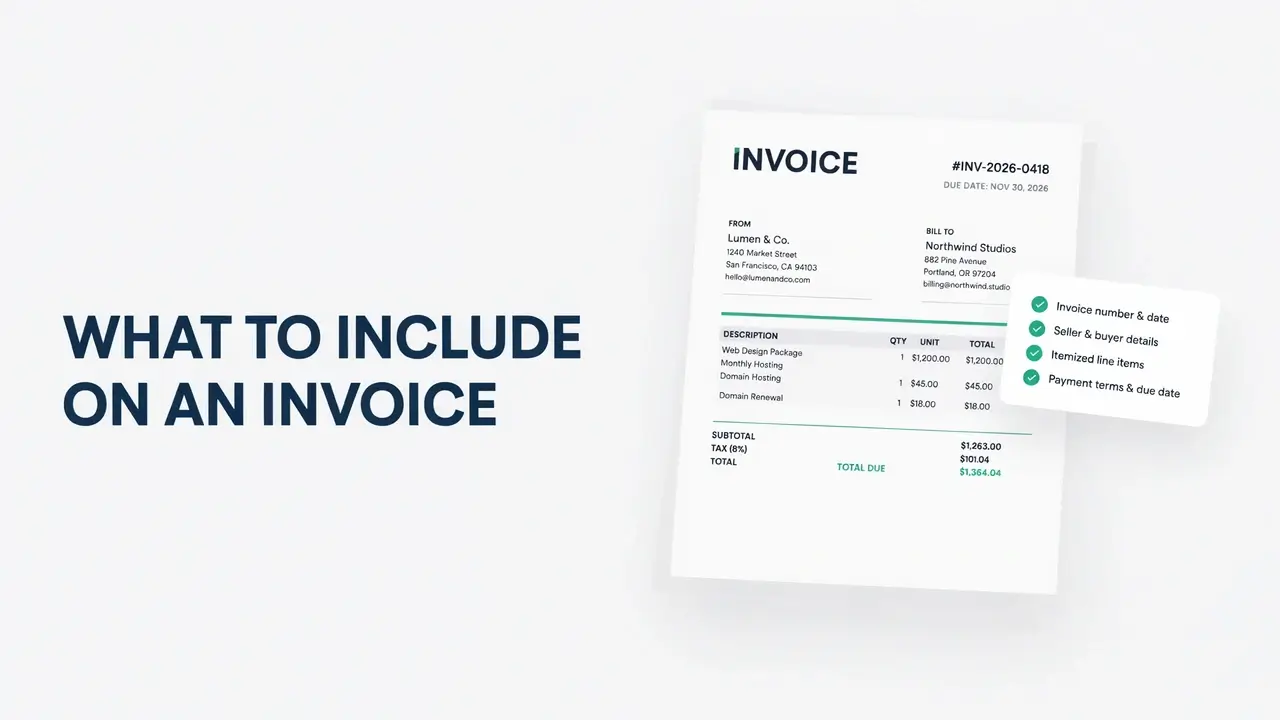
- Invoice heading: Clearly identify the document as an invoice.
- Business information: Your business name, address, and contact details.
- Customer information: The name and billing details of the person or business being charged.
- Invoice number: A unique reference that identifies the transaction.
- Invoice date: The date the invoice was issued.
- Service or delivery date: When the work was completed or the goods were supplied, where applicable.
- Itemized description: A clear explanation of the products or services provided.
- Quantity and pricing: Units, hours, rates, and individual charges.
- Taxes and discounts: Applicable tax amounts and agreed adjustments.
- Total amount due: The final amount the customer must pay.
- Payment terms: The due date and any agreed payment conditions.
- Payment instructions: How the customer can complete the payment.
These are recommended fields for an ordinary professional invoice. Not every field is legally required for every transaction.
For example, an invoice issued by a US freelancer may differ from a VAT invoice issued by a UK-registered business.
Once you have the necessary details, you can use our free invoice generator to prepare a professional invoice without designing the document from scratch.
Invoice Requirements: 10 Essential Details Explained
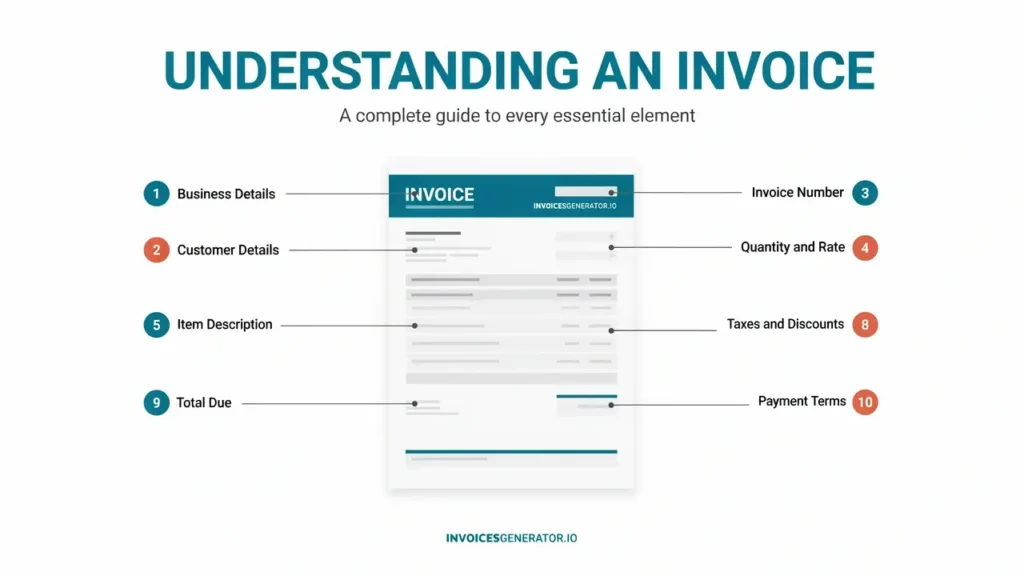
Understanding the purpose of each invoice field helps you create documents that are easy for customers to understand and process.
1. Invoice Heading and Business Details
Start with a clear heading such as Invoice so the customer immediately understands the document’s purpose.
Below the heading, identify the person or business requesting payment.
Typical seller information includes:
- Registered business or trading name
- Business address
- Email address
- Phone number, if appropriate
- Website, if relevant
- Required tax registration information
For example:
Brightline Creative Studio
245 Market Street, Suite 200
San Francisco, CA 94105
Email: billing@example.com
A clear business identity makes it easier for customers to recognize the sender and contact the correct person if they have a billing question.
Some jurisdictions require particular legal names, addresses, or registration numbers. Check the requirements that apply to your business.
2. Customer Name and Billing Information
An invoice should identify who is responsible for payment.
For an individual customer, this may be their full name and billing address. For a business customer, include the company’s correct name and the relevant billing or accounts payable details.
Customer information commonly includes:
- Customer or company name
- Billing address
- Contact person or department
- Billing email address
- Customer reference, if needed
For example:
Bill To:
Oakridge Consulting LLC
580 West Avenue
Austin, TX 78701
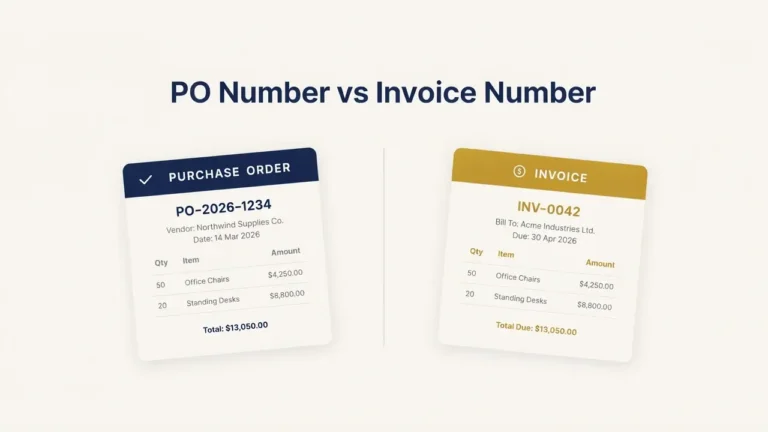
If a customer uses a purchase order system, they may also ask you to include a PO number.
A purchase order number is different from your invoice number. Learn more in our guide to PO number vs invoice number.
Always verify the billing details before issuing an invoice. Incorrect names or missing references may delay internal approval.
3. Unique Invoice Number
An invoice number is a unique identifier used to track a particular invoice.
It helps businesses locate records, match payments, respond to customer questions, and avoid duplicate billing.
Common invoice number examples include:
- INV-001
- INV-2026-001
- CLIENT25-004
- 2026-INV-125
You can use a simple numbering system or a structured format containing a year, customer code, or business reference.
For example, a freelancer could use INV-2026-001 for the first invoice issued in 2026 and INV-2026-002 for the next.
The important consideration is consistency and avoiding duplicate identifiers.
Unique or sequential numbering is also specifically required for certain types of invoices, including UK invoices.
For a detailed explanation, read What Is an Invoice Number?.
4. Invoice Issue Date
The invoice date identifies when the document was issued.
This date is useful for bookkeeping, payment tracking, and determining when a payment deadline begins.
For example:
Invoice Date: October 18, 2026
If the customer has agreed to Net 30 payment terms based on the invoice date, the payment deadline would ordinarily fall 30 calendar days after October 18, unless the agreement provides another calculation method.
Avoid leaving the invoice date blank. It can create confusion when customers review invoices or organize their financial records.
5. Service or Delivery Date
The service or delivery date indicates when the products or services were actually supplied.
This date may differ from the invoice issue date.
For example:
- Service completed: October 12, 2026
- Invoice issued: October 18, 2026
For ongoing services, it may be clearer to include a billing period.
Example:
Service Period: October 1–15, 2026
This information helps customers understand exactly which work or delivery the charges relate to.
In some countries, such as the UK, the supply date is also part of the required invoice information.
6. Description of Products or Services
Every invoice should explain what the customer is paying for.
Avoid vague descriptions such as “Work completed” or “Professional services” when a more specific description is available.
Instead, describe the actual deliverable or service.
Examples include:
- Website homepage design and responsive layout
- Logo design with three initial concepts
- Monthly bookkeeping services for September
- Product photography session covering 25 items
- Office cleaning services for October
An effective item description should allow the customer to understand the charge without searching through previous emails or contracts.
For projects involving multiple deliverables, use separate line items.
This makes the invoice more transparent and simplifies payment approval.
7. Quantity, Unit Price, and Subtotal
Itemized pricing shows how individual charges contribute to the invoice total.
Depending on your business, the quantity might represent products, hours, sessions, days, or completed deliverables.
For example:
| Service | Quantity | Rate | Amount |
|---|---|---|---|
| Website design | 1 project | $500 | $500 |
| Content writing | 5 pages | $60 | $300 |
| Website maintenance | 4 hours | $40 | $160 |
| Subtotal | $960 |
The calculation is straightforward:
Line Item Amount = Quantity × Unit Price
For the maintenance service:
4 hours × $40 = $160
The subtotal is the sum of all individual charges before applicable discounts and taxes.
Providing this breakdown reduces confusion and makes the document easier to review.
8. Taxes, Discounts, and Additional Charges
An invoice should clearly show applicable taxes, discounts, and agreed additional charges.
The exact tax information required depends on the business location, customer, transaction, and applicable tax laws.
Possible tax details include:
- Sales tax
- Value Added Tax (VAT)
- Goods and Services Tax (GST)
- Harmonized Sales Tax (HST)
- Tax registration numbers, where required
Not every business must charge these taxes. For example, tax registration thresholds, exemptions, and the taxability of particular services vary by jurisdiction.
If you offer a discount, show how it affects the amount payable.
For example:
Subtotal: $960
Discount (10%): −$96
Amount after discount: $864
Illustrative tax (5%): $43.20
Total Due: $907.20
The 5% tax rate above is only a calculation example. It does not represent a recommended or universally applicable tax rate.
Only apply taxes that you are legally required or authorized to collect, and identify how they are calculated.
Likewise, additional fees should reflect the customer’s agreement and any applicable legal restrictions.
9. Total Amount Due
The total amount due is one of the most important parts of an invoice.
It tells the customer exactly how much to pay after all applicable charges, discounts, taxes, and previous payments have been considered.
The amount should be easy to find, ideally near the bottom of the itemized charges.
For example:
Total Amount Due: USD $907.20
If the customer has already paid a deposit, distinguish the original total from the remaining balance.
For instance:
Invoice Total: $1,000
Deposit Received: $250
Remaining Balance Due: $750
For international invoices, identify the payment currency clearly.
Avoid displaying only a dollar symbol when the transaction could involve USD, CAD, AUD, or another dollar-denominated currency.
10. Payment Due Date, Terms, and Instructions
Payment information explains when the customer must pay and how to make the payment.
Common payment terms include:
| Payment term | Meaning |
|---|---|
| Due on receipt | Payment is expected when the invoice is received |
| Net 7 | Payment is due within seven days |
| Net 15 | Payment is due within fifteen days |
| Net 30 | Payment is due within thirty days |
| Net 60 | Payment is due within sixty days |
The precise starting date and calculation should follow the agreement between the parties.
For clarity, include an actual due date even when using terms such as Net 30.
Example:
Payment Terms: Net 30
Payment Due: November 17, 2026
You should also explain how the customer can pay.
Depending on your available payment arrangements, you might provide bank transfer instructions, a secure payment link, or another agreed payment method.
Never include sensitive login credentials or unnecessary financial information on an invoice.
If late payment fees apply, they should be disclosed consistently with the customer agreement and relevant law.
Required vs Optional Invoice Information
Not every detail commonly found on an invoice is legally mandatory.
Some fields are required under particular tax or invoicing regulations, others are recommended for accurate recordkeeping, and some are optional design features.
The following table provides a practical comparison.
| Invoice detail | General classification |
|---|---|
| Seller identity | Core information; legally required in many jurisdictions |
| Customer information | Core information; exact legal requirements vary |
| Invoice number | Standard practice; mandatory under some rules |
| Invoice issue date | Core information; legally required in many jurisdictions |
| Supply date | Required in some jurisdictions or transaction types |
| Description of goods or services | Core information |
| Quantity and pricing | Core information; required details vary |
| Tax information | Required when applicable under tax rules |
| Total amount payable | Core information |
| Payment due date | Strongly recommended; contractual or legal relevance varies |
| Payment instructions | Recommended |
| Company logo | Generally optional |
| Purchase order number | Required if the customer or contract calls for it |
| Thank-you message | Optional |
| Signature | Not universally required; may be needed in special circumstances |
The classification is general guidance rather than a universal legal checklist.
A normal commercial invoice and a statutory tax invoice may have different requirements.
For most small businesses, the practical approach is to include complete transaction and payment information while checking any additional rules that apply locally.
What Does a Professional Invoice Look Like?
A professional invoice usually has a clear layout with business information at the top, customer details and invoice identifiers underneath, an itemized table in the middle, and totals and payment instructions near the bottom.
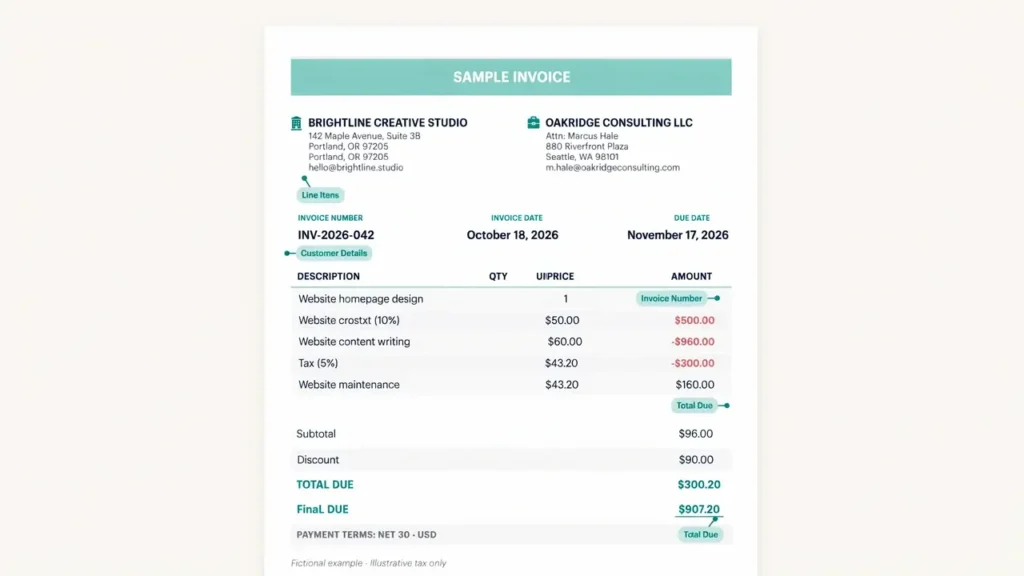
Here is a complete example.
Sample Invoice
INVOICE
From:
Brightline Creative Studio
245 Market Street, San Francisco, CA 94105
Bill To:
Oakridge Consulting LLC
580 West Avenue, Austin, TX 78701
Invoice Number: INV-2026-042
Invoice Date: October 18, 2026
Service Period: October 1–15, 2026
Payment Due: November 17, 2026
Currency: USD
| Description | Quantity | Rate | Amount |
|---|---|---|---|
| Website homepage design | 1 | $500 | $500 |
| Website content writing | 5 | $60 | $300 |
| Website maintenance | 4 hours | $40 | $160 |
| Subtotal | $960 | ||
| Discount (10%) | −$96 | ||
| Illustrative tax (5%) | $43.20 | ||
| Total Due | $907.20 |
Payment Terms: Net 30
Payment Method: Bank transfer using the separately provided payment instructions.
Payment Reference: INV-2026-042
Thank you for your business.
This is a fictional example. The tax treatment, business information, and payment arrangements are illustrative and should be adapted to the actual transaction.
Why This Invoice Format Works
The example includes clear seller and customer information, a unique invoice number, billing dates, an itemized description of services, and a visible final amount.
Each charge can be checked against the agreed service.
The payment deadline and reference number also make the invoice easier to process.
Your invoice does not need an elaborate design. A clean document with accurate information is generally more useful than a decorative template that makes important details difficult to find.
If you’re creating your first invoice, our guide on how to write an invoice explains the full process from preparing the details to sending the completed document.
Invoice Requirements by Country
Invoice requirements differ across countries, particularly when sales taxes, VAT, GST, or other regulatory obligations apply.
The following overview highlights important distinctions for businesses operating in major English-speaking markets.
United States
In the United States, there is no single federal commercial-invoice format that applies to every ordinary business transaction.
Invoice requirements can depend on state laws, sales tax obligations, business type, industry, customer contracts, and the nature of the sale.
A practical US business invoice generally includes:
- Seller and customer information
- Invoice number and date
- Description of products or services
- Itemized prices and totals
- Applicable sales tax
- Payment terms and instructions
Some transactions have additional recordkeeping or tax-documentation requirements.
For example, an ordinary service invoice is not the same thing as an IRS information return such as Form 1099.
Businesses should verify applicable state and local tax rules rather than assuming that every invoice needs a federal tax identification number.
United Kingdom
UK invoice rules are more explicitly defined.
According to GOV.UK, invoices must include information such as:
- A unique identification number
- Supplier name, address, and contact details
- Customer name and address
- Clear description of the goods or services
- Date the goods or services were supplied
- Invoice date
- Amounts charged
- VAT amount, where applicable
- Total amount owed
Additional identification requirements apply to sole traders and limited companies.
VAT-registered businesses may also need to issue VAT invoices containing additional prescribed information, including VAT registration details and tax calculations.
See HMRC’s VAT Guide for the detailed VAT-invoice rules.
Australia
In Australia, GST-registered businesses generally use tax invoices for taxable sales when required.
The Australian Taxation Office specifies information that tax invoices must clearly establish.
For taxable sales below A$1,000, relevant details include:
- Identification of the document as a tax invoice
- Seller identity
- Australian Business Number (ABN)
- Issue date
- Description, quantity where applicable, and price
- GST amount
- Information indicating the extent to which supplies are taxable
For sales of A$1,000 or more, additional information identifying the buyer or their ABN is required.
An ordinary invoice issued by a business that is not registered for GST should not incorrectly represent GST as being charged.
Canada
In Canada, GST/HST registrants have specific requirements relating to tax disclosure and supporting documentation.
The Canada Revenue Agency distinguishes documentation requirements according to the transaction value.
For supporting input tax credit claims, the principal categories are:
- Sales under C$100
- Sales from C$100 to C$499.99
- Sales of C$500 or more
The required information becomes more detailed at higher amounts.
Depending on the transaction, documentation can include supplier information, invoice dates, GST/HST registration details, tax amounts, and purchaser identification.
Businesses should also account for applicable provincial rules, including Quebec’s separate QST system.
For current guidance, consult the Canada Revenue Agency’s input tax credit requirements.
What About South Africa?
South African VAT rules distinguish between full and abridged tax invoices, with requirements based partly on transaction value.
Businesses registered for VAT should follow the documentation rules published by the South African Revenue Service.
Important: Country-specific information above is a general overview, not a complete statement of every tax or legal requirement. Always verify the rules that apply to your business and transaction, especially for cross-border sales and regulated industries.
Common Invoice Mistakes to Avoid
Even a professional-looking invoice can cause problems when important details are incorrect or missing.
Using an Incorrect Customer Name
Sending an invoice to the wrong company or billing entity can delay approval and payment.
Always confirm the customer’s official billing details before issuing the document.
Forgetting the Invoice Number
Missing or duplicate invoice numbers make it harder to match payments with outstanding balances.
Use a consistent numbering system and keep records of previously issued invoices.
Providing Vague Descriptions
Descriptions such as “services provided” offer little context.
Specify the actual work, products, quantity, or billing period so the customer understands the charge.
Entering Incorrect Totals
Calculation errors can result in disputes, revised invoices, and additional administrative work.
Check quantities, unit prices, discounts, taxes, previous payments, and the final balance before sending.
Leaving Payment Terms Unclear
An invoice that states only “payment required” may not communicate the agreed deadline.
Include the actual due date, payment method, and relevant payment reference.
Adding Incorrect Taxes
Do not assume that every invoice must include sales tax, VAT, or GST.
Tax obligations vary according to registration status, location, customer type, and the taxable nature of the transaction.
Including Unexpected Fees
Late fees, delivery charges, and other additions can create disputes when customers have not agreed to them or when they are not legally permitted.
Confirm the basis for extra charges before including them.
Invoice Best Practices for Getting Paid on Time
Accurate invoice information helps reduce avoidable payment delays, but the way you manage invoices is equally important.
Send invoices promptly. Issue the invoice according to the agreed billing schedule, rather than waiting until the customer asks for it.
Use consistent formatting. A familiar invoice layout helps customers and accounts payable teams recognize and process your documents.
Make payment instructions clear. Include the agreed method, due date, currency, and any payment reference the customer needs.
Keep invoice records organized. Retain copies of issued invoices, payment confirmations, and relevant communications according to your accounting and legal obligations.
Confirm customer billing requirements. Some businesses need a purchase order reference, department code, vendor ID, or designated email address.
Follow up professionally. If an invoice becomes overdue, begin with a polite payment reminder containing the invoice number, amount due, and relevant payment information.
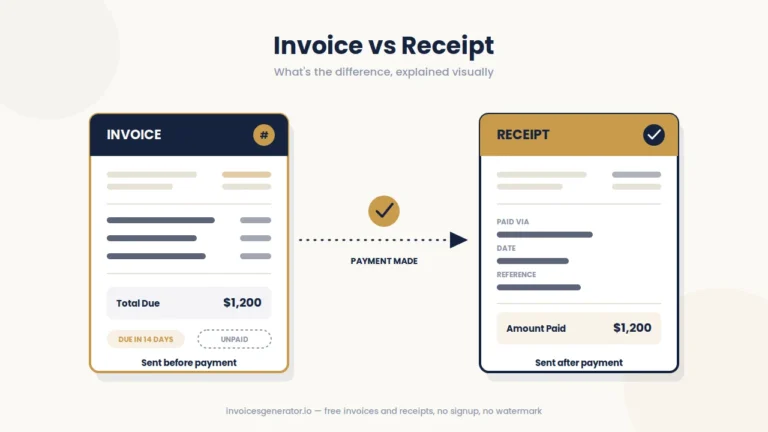
An invoice records the payment request, while a receipt generally confirms that payment has been received. If you need to acknowledge a completed transaction, you can use our free receipt generator.
For additional context, read our explanation of invoice vs receipt.
Final Invoice Checklist Before Sending
Before sending an invoice to a customer, take a moment to review these details.
- Is the document clearly identified as an invoice?
- Are your business name and contact details correct?
- Is the customer’s billing information accurate?
- Does the invoice have a unique number?
- Is the invoice date correct?
- Have you included the relevant service or delivery date?
- Are products or services described clearly?
- Do quantities and rates match the agreement?
- Have you calculated discounts and taxes correctly?
- Is the total amount due accurate?
- Is the payment deadline clear?
- Are payment instructions included?
- Have you checked any applicable legal or tax requirements?
A quick review can prevent many of the mistakes that otherwise lead to customer questions, corrections, or delayed payments.
Frequently Asked Questions
What information must be included on an invoice?
A professional invoice typically includes seller and customer details, an invoice number, issue date, itemized products or services, pricing, applicable taxes, total amount due, and payment instructions. The information legally required depends on the country and transaction.
Does an invoice need an invoice number?
An invoice number is strongly recommended for tracking and bookkeeping. Unique or sequential identification is also mandatory under certain invoicing rules, including UK requirements. In the US, the legal position depends on the applicable transaction and regulations.
Does an invoice need a business address?
Business addresses are required under some invoicing laws, including UK rules. Elsewhere, requirements can vary. Including an appropriate business address is generally useful for identification and recordkeeping.
Do invoices need a due date?
A due date is strongly recommended because it tells customers when payment is expected. Whether a particular date or payment-term statement is legally required depends on the relevant laws and contract.
Can I send an invoice without a tax ID?
In some situations, yes. A US freelancer issuing an ordinary invoice, for example, may not need to display a federal tax ID on that document. However, VAT, GST, and other tax-invoice rules may require specific registration numbers. Check the requirements relevant to your business.
Does an invoice require a signature?
A handwritten or electronic signature is not universally required on ordinary commercial invoices. Certain contracts, regulated transactions, and document types may have additional authentication requirements.
What is the difference between an invoice and a tax invoice?
An ordinary invoice requests payment for goods or services. A tax invoice is a document that meets the additional requirements of a particular tax system, such as VAT or GST. The distinction and required contents depend on the jurisdiction.
Can freelancers use the same invoice format as businesses?
Yes. Freelancers can use a standard invoice layout containing their professional details, customer information, descriptions of services, rates, totals, and payment instructions. They should also include any information required by local law or customer agreements.
What should you avoid putting on an invoice?
Avoid unnecessary sensitive information, incorrect tax charges, vague service descriptions, unagreed fees, misleading business details, and outdated payment instructions. Keep the document accurate, relevant, and easy to understand.
Create Your Invoice for Free
A professional invoice should make payment straightforward for both you and your customer. Clear business information, accurate charges, unique identification, and understandable payment terms help reduce unnecessary questions and keep financial records organized.
The exact legal requirements may vary, but the goal remains the same: provide a complete, accurate record of what is being charged and how payment should be made.
Instead of formatting an invoice manually every time, use our free online invoice generator to prepare an itemized invoice with the details your customer needs.
Review the completed invoice, confirm your calculations and applicable requirements, and send it to your customer using your preferred method.